Divorce and Your Credit Score in Canada: Recovery Guide
How divorce affects your credit score in Canada. Steps to separate joint accounts, protect your rating during separation, and rebuild credit independently.

Product Manager in Fintech · Montreal, Canada
Ready to start recovering? Our free quiz creates a personalized plan for your exact situation.
Take the Free Quiz →I divorced in Canada in 2023. In Montreal, with three kids and a mortgage that had both our names on it. And I can tell you with complete certainty that nobody — not my lawyer, not my bank, not a single person — told me what was about to happen to my credit score.
My Equifax score was sitting around 750 when the separation started. By the time the financial dust settled, it had dropped to 650. Not because I missed payments on purpose. Not because I went bankrupt. Because of joint accounts, overlapping debt obligations, and the slow-motion financial unravelling that comes with splitting one household into two. If you’re in that situation right now — or heading toward it — this article is the thing I wish someone had handed me in early 2023.
Before we get into the specifics, take two minutes to do the Credit Score Recovery Quiz. It’ll give you a personalized recovery roadmap based on your actual situation, including where you are in the separation process.
Does Divorce Itself Lower Your Credit Score in Canada?
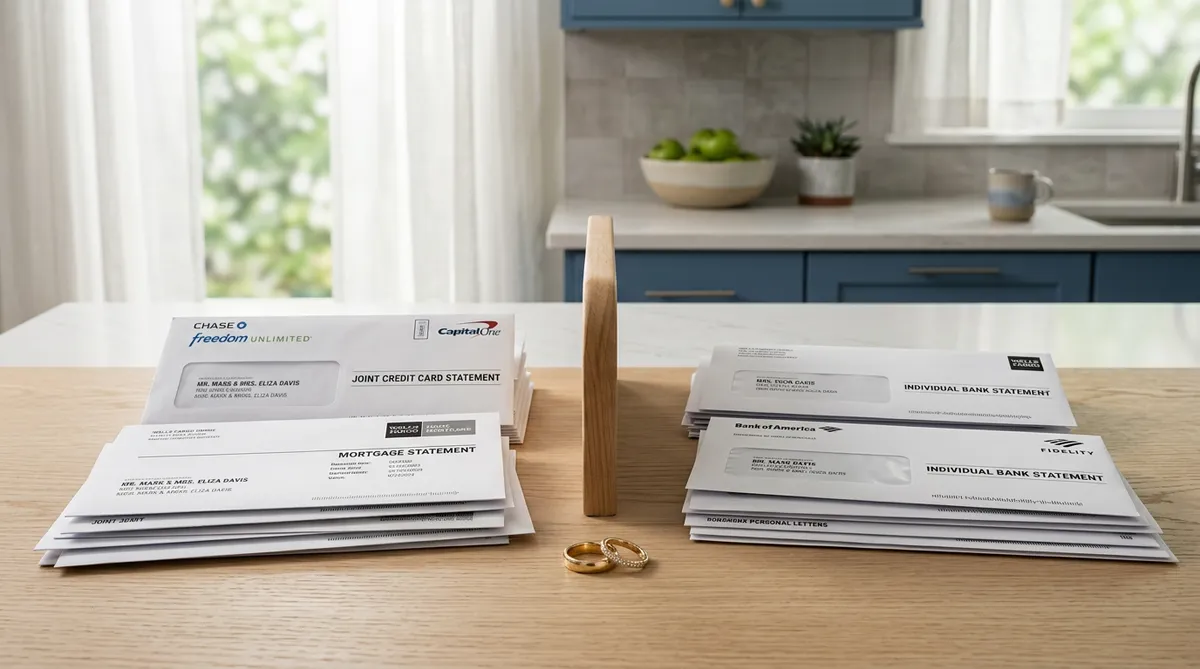
No. Divorce does not appear on your Equifax Canada or TransUnion Canada credit report. There is no “divorced” flag, no separation penalty, and no direct score hit from the legal act of divorcing. But — and this is the part nobody explains — the financial fallout from separation causes serious credit damage for most Canadian couples, often without either person realizing it’s happening.
According to Statistics Canada, approximately 38 percent of Canadian marriages end in divorce. Most of those couples have finances that are genuinely tangled together: joint credit cards, shared lines of credit, co-signed car loans, a mortgage in both names. When the relationship ends but those financial ties don’t — that’s where the damage happens.
What Actually Destroys Your Credit During a Canadian Separation?
The credit damage from divorce comes from a few specific, predictable sources. Knowing them in advance means you can protect yourself.
Missed payments on joint accounts. This is the one that catches people off guard. During separation, one spouse stops paying their share of a joint credit card or line of credit — sometimes out of spite, sometimes out of genuine financial hardship, sometimes because they assumed the other person was handling it. Under Canadian law, both names on a joint account means both people are 100 percent liable for the full balance. One missed payment drops your score by 50 to 100 points on Equifax, and it stays on both reports for six years from the date of the missed payment.
Legal costs destroying your utilization ratio. Canadian divorce legal fees range from $1,500 for a simple uncontested case to $25,000 or more when it gets contested. A lot of people put those fees on joint credit cards or max out individual cards to cover the cost of suddenly running two households. Credit utilization — the percentage of your available limit you’re using — accounts for roughly 30 percent of your credit score calculation. Spike that number and your score drops fast.
Debts going to collections. When neither spouse takes responsibility for a shared debt, it eventually lands with a collections agency. In Canada, a collection account stays on your Equifax and TransUnion reports for six years from the date of last activity in most provinces. In some provinces it’s seven years. It’s one of the most damaging things that can appear on a credit report.
The mortgage sitting in both names. Even if a separation agreement awards the home to one spouse, the mortgage remains the legal obligation of both people until it’s formally refinanced. If the spouse living in the home misses a payment, both credit scores take the hit equally. And in Canada, breaking a fixed-rate mortgage early means a prepayment penalty — typically the greater of three months’ interest or the Interest Rate Differential. That can run to tens of thousands of dollars, which creates its own financial crisis.
If the mortgage is your main concern right now, read our guide on what credit score you need for a mortgage in Canada before making any decisions about refinancing into your own name.
How Does Quebec Handle Joint Debt Differently From Other Provinces?
In Quebec, the Civil Code of Quebec governs family patrimony for married and civil union spouses. It mandates equal partition of family patrimony — which includes the family residence, household furnishings, certain vehicles, and registered retirement plans — but does not automatically split all debts equally the way some people assume. This is different from Ontario’s Family Law Act or BC’s Family Law Act (BC), which take their own approaches to equalization.
I’m in Montreal, so Quebec law applied to me directly. What I learned the hard way: a separation agreement that assigns a joint debt to your ex does not release you from that debt with the creditor. The bank doesn’t care what your agreement says. They signed a contract with both of you. If payments stop, they’ll come after both of you and report the missed payments to both credit bureaus.
The only paths that actually work: pay off the joint debt, refinance it into one name, or negotiate a formal release directly with the lender. Anything short of that leaves you exposed.
For the legal side of things, Educaloi is an excellent free resource if you’re in Quebec — it explains the Civil Code family patrimony rules in plain language without requiring a law degree.
What Should You Do in the First 30 Days After Separation?
The moment you decide to separate, treat your credit like an emergency. Here’s what to do immediately, in order.
Pull both credit reports right now. Sign up for Borrowell to get free weekly Equifax score monitoring, and order your TransUnion report directly from their site. Go through every line and list every account where both names appear: joint credit cards, shared lines of credit, co-signed loans, authorized user arrangements, the mortgage. That list is your action list. Every item on it is a liability until it’s dealt with.
Freeze joint credit cards against new charges. In Canada, major issuers — TD, RBC, CIBC, BMO, Scotiabank — will generally let you freeze a joint card unilaterally. You don’t need your spouse’s permission to stop new purchases. You’re still both responsible for the existing balance, but at least you can stop it from growing. Do not close cards that carry a balance without paying them down first; removing that credit limit spikes your utilization ratio.
Update your address everywhere. This sounds trivial. It isn’t. A bill sent to your old shared address that you never see is still a missed payment on your credit report. Update your address with Equifax, TransUnion, and every financial institution you deal with on day one.
Report your CRA change in marital status. The Canada Revenue Agency requires you to report a change in marital status by the end of the month following the month separation begins. This affects your Canada Child Benefit (CCB) payments and GST/HST credit. Your cash flow will change, and that affects your ability to keep up with debt payments. Do this early, not at tax time.
One thing I didn’t do well enough at first: I kept assuming my ex was handling certain joint bills. She assumed I was handling them. We weren’t communicating about money at all. Two payments slipped. Document every single financial conversation during separation in writing — email, text, it doesn’t matter. You need a paper trail.
How Do You Rebuild Credit Independently After Divorce in Canada?
Once your finances are separated, your credit file may look thin. Years of joint accounts closing means your individual credit history is short. Here’s how to build it back.
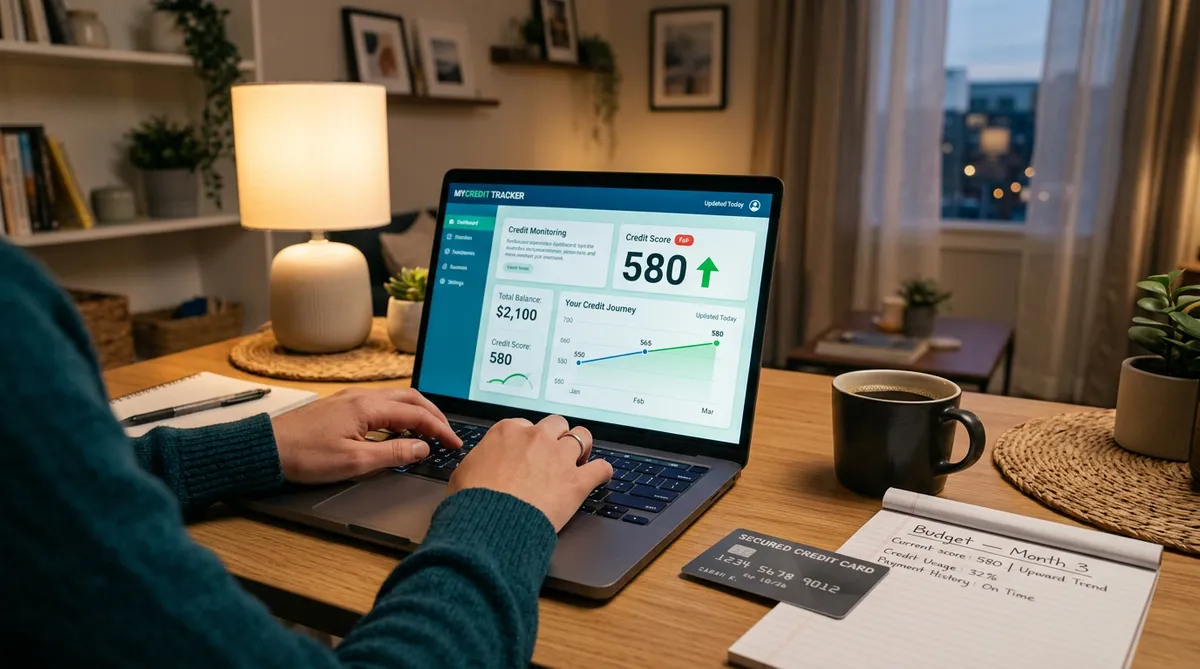
Start with a secured credit card. The Capital One Secured Mastercard is the most straightforward option in Canada — no annual fee, guaranteed approval for Canadian residents, $200 to $500 deposit that becomes your limit. Use it for one small recurring expense like a $15 streaming subscription. Pay the full balance every month. That single habit, maintained consistently, does more for your score than anything else.
For a full comparison of your options, see our guide to the best secured credit cards for bad credit in Canada 2026.
Consider KOHO’s credit builder. KOHO’s credit building feature costs $10 per month (or is included in some premium tiers) and reports to Equifax monthly. If your score is below 600 and you can’t get approved for even a secured card, this is worth it. If you already have a secured card and your score is above 620, you probably don’t need both — pick one and stay consistent.
Keep utilization below 30 percent. When joint accounts close, your total available credit shrinks. If you’re carrying any balance on your remaining individual cards, your utilization ratio spikes fast. On a $300 secured card limit, 30 percent means keeping your balance below $90 at statement time. Below 10 percent is even better for score purposes.
Space out new credit applications. Hard inquiries — the kind triggered by credit applications — temporarily lower your score by a few points each. I learned this the hard way when I was trying to finance a refrigerator through CityBank while buying our home. They sent a hard inquiry, I waited three weeks for a decision, and they declined me. My score dropped 20 points for an application that went nowhere. Space applications at least three to six months apart.
Report rent if you’re renting. If you moved out and you’re renting after separation, services like Chexy can report your monthly rent payments to Equifax and TransUnion. Rent is likely your largest monthly expense — getting credit for those on-time payments accelerates score recovery significantly. Read our related article on whether a landlord can deny you for bad credit in Ontario if you’re worried about renting with a damaged score.
Check your reports for settlement errors. Divorce settlements are messy, and credit bureaus don’t automatically update when debts change hands through a court order. A debt that was paid off in the settlement may still show as outstanding on your report. Use our free dispute letter template to file corrections with Equifax and TransUnion. I recommend reading our full guide on how to dispute credit report errors in Canada if you find anything wrong.
I monitor my credit through Credit Karma Canada — it’s free and updates regularly. The reason I bother: once, Credit Karma flagged a new credit product that had appeared on my file for a SIM card I’d signed up for thinking it was free. It wasn’t free — a monthly charge had started, the account was live, and I would have completely missed it without monitoring. Caught it early and cancelled before it became a problem.
How Long Does Credit Recovery After Divorce Actually Take?
Most people see meaningful recovery within 12 to 24 months of consistent effort. That’s not a guarantee — it depends heavily on how much damage happened and whether there are collection accounts or derogatory items on your report.
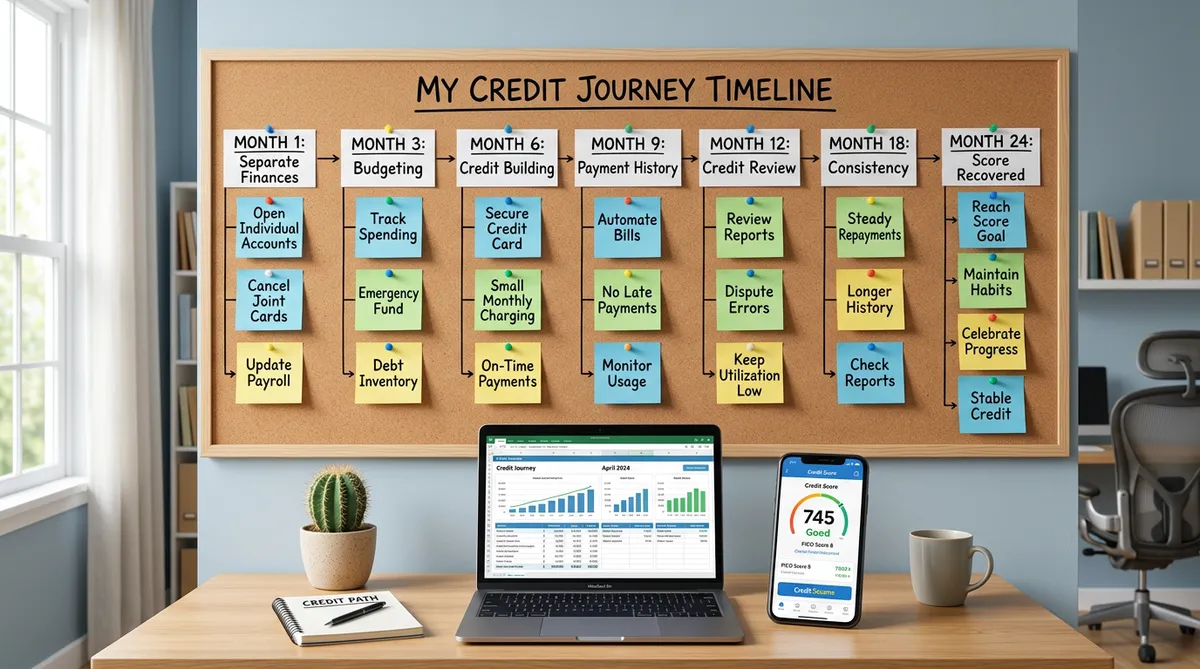
Months 1 to 3: Separate all finances. Freeze or close joint accounts. Set up credit monitoring through Borrowell or Credit Karma Canada. Open a secured credit card. Build a budget based on your income alone — not the dual-income one you had before.
Months 3 to 6: Establish consistent on-time payment history on your individual accounts. Dispute any errors from the divorce settlement. Your score may still be declining during this phase as old joint account issues work through the system — that’s normal. Don’t panic.
Months 6 to 12: New positive payment history starts outweighing old damage. Utilization stabilizes as you pay down balances. After six months of clean payments on one card, you can consider applying for a second credit product.
Months 12 to 24: Meaningful score improvement. Most people see a 100 to 150 point increase from their post-divorce low during this window. You’re building a genuinely independent credit profile.
Months 24 to 36: Your credit profile is established in your own name. You’re in a position to qualify for a car loan or eventually a mortgage on your own terms.
My score went from 750 before separation to 650 at the worst point, and as of February 2026 it’s back to 820 — higher than it was before the divorce. Getting a mortgage in my own name was the turning point. It added a major credit product to my individual file and the consistent payment history started compounding.
Not sure where you sit on this timeline? The Credit Score Recovery Quiz takes 90 seconds and gives you a personalized action plan based on your actual score and situation.
Frequently Asked Questions
Does getting divorced in Canada directly lower your credit score?
No. Divorce is not reported to Equifax Canada or TransUnion Canada and does not appear on your credit report. The damage comes from the financial fallout: missed payments on joint accounts, high utilization from closing shared credit lines, debts sent to collections. The divorce itself is not the problem — how the shared financial obligations get handled (or ignored) during and after separation is what causes credit damage.
Can my ex-spouse’s debts after our divorce affect my credit in Canada?
Only if your name still appears on those accounts — as a joint holder, co-signer, or authorized user. A separation agreement assigning debt to your ex does not remove you from the original credit contract. The creditor can still report missed payments to your file and pursue you for the full balance. The only real protection is getting your name removed through payoff, refinancing, or a formal lender release.
Should I close all joint accounts immediately when I separate?
Freeze them against new charges immediately. Closing is more complicated — eliminating a credit limit raises your utilization ratio, which can drop your score further if you’re carrying balances elsewhere. Pay off the balance first, then close. If you can’t pay it off right away, freeze it, document the plan in writing with your ex, and work toward paying it down before formally closing.
What happens to a joint mortgage during a divorce in Canada?
The mortgage stays the legal obligation of both spouses until it’s refinanced into one name or the property sells and the mortgage discharges. A court order awarding the home to one spouse does not remove the other from the mortgage. If payments stop, both scores are affected equally. Refinancing requires the remaining spouse to qualify independently — typically 600+ for a B-lender, 680+ for an A-lender. If that’s not possible, selling is usually the only option that cleanly protects both credit files.
What if my post-divorce debt is unmanageable?
Talk to a Licensed Insolvency Trustee (LIT) — the first consultation is free. They can explain whether a consumer proposal makes sense for your situation. A consumer proposal in Canada stays on your Equifax report for 3 years after completion; bankruptcy stays for 6 to 7 years after discharge (varies by province). Read our guide on consumer proposals in Canada and how they affect your credit before making any decisions about insolvency.
This article contains affiliate links to financial products including Borrowell, KOHO, Capital One, and Chexy. If you sign up through these links, Credit Score Recovery may receive a commission at no extra cost to you. We only recommend products we have personally used or thoroughly researched. Our editorial content and recommendations are not influenced by our affiliate partnerships. For full details, see our Affiliate Disclosure.
Get Your Personalized Recovery Plan
Answer 6 quick questions and get a step-by-step plan tailored to your situation.
Take the Free Quiz Product manager in fintech, immigrant to Canada, and founder of Credit Score Hero. I moved from Kyrgyzstan to Montreal in 2022 and built this site to help Canadians navigate the credit system with free tools and honest, Canada-specific advice.
Related Recovery Guides
After Bankruptcy
Month-by-month recovery plan for Canada
Student Debt Recovery
Guide for Canadians with student debt problems
After Payday Loans
Rebuilding credit after the payday loan trap
Best Secured Cards 2026
Compare secured credit cards for rebuilding in Canada
Renting with Bad Credit (Ontario)
Your rights as a renter under the Human Rights Code