Canadian Student Debt Credit Recovery Guide (2026)
How to recover your credit score from student loan damage in Canada. Covers RAP, NSLSC, the 15-year forgiveness rule, CRA collections, and rebuilding.

Product Manager in Fintech · Montreal, Canada
Ready to start recovering? Our free quiz creates a personalized plan for your exact situation.
Take the Free Quiz →The Scale of Student Debt in Canada
The average Canadian graduate finishes school owing between $26,000 and $28,000 in student loans. For those who completed graduate or professional programs, that figure can exceed $60,000. According to Statistics Canada, roughly three million Canadians are currently carrying student loan debt, and a significant portion of them are struggling with the credit damage that comes from falling behind on payments.
If your student loans have already hurt your credit score, this guide will walk you through every Canadian-specific program, strategy, and tool available to recover. If you are still current on payments but barely holding on, what follows could prevent the damage from happening in the first place.
Not sure where your credit stands right now? Take our free credit recovery quiz to get a personalized action plan based on your situation.
Why This Hit Close to Home
When I moved to Montreal from Kyrgyzstan in 2022, I was fortunate not to carry student debt — education back home cost a fraction of what Canadians pay. But at the financial company where I work, I see how crushing Canadian student loan payments can be for people trying to build their lives. A colleague was paying $600 per month on OSAP while trying to save for a car and build credit simultaneously. The math barely works. And the cruel irony: the people who need credit the most (to rent an apartment, buy a car for work, qualify for better financial products) are the same ones whose credit scores are damaged by student loan strain. It is a cycle I see repeated constantly.
How Student Loans Affect Your Credit Score in Canada
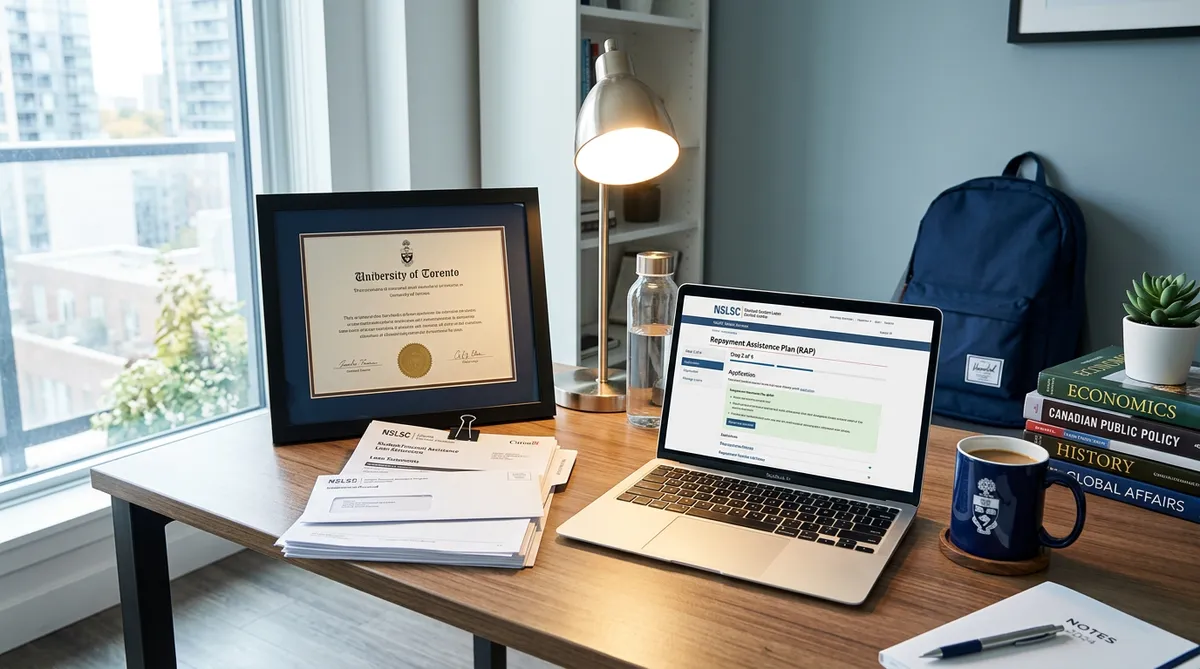
Student loans from the Canada Student Financial Assistance Program (CSFAP), OSAP, and other provincial programs are reported to Equifax and TransUnion just like any other installment loan. That means every payment, missed payment, and default shows up on your credit report.
Here is how each factor plays out:
- Payment history (35% of your score): This is the single largest factor. One payment that is 30 or more days late can drop your score by 50 to 100 points. A string of missed payments can push you below 500.
- Credit utilization and balances (30%): Large outstanding student loan balances relative to the original amounts borrowed affect your score. As you pay down the principal, this factor gradually improves.
- Account age (15%): Student loans are often among the oldest accounts on a young Canadian’s credit file. Keeping them in good standing contributes positively to the average age of your credit history.
- Credit mix (10%): Having an installment loan (student debt) alongside revolving credit (a credit card) is viewed favourably by scoring models.
- New inquiries (10%): Applying for repayment assistance or consolidation does not typically generate a hard inquiry. However, applying for a private consolidation loan will.
Use our credit score calculator to estimate where your score might be based on your current payment history and debt levels.
The Grace Period: What Actually Happens After Graduation
After you finish school, federal Canada Student Loans give you a six-month non-repayment period. During this time, no payments are required. Here is the critical detail that many graduates get wrong:
As of April 1, 2023, federal Canada Student Loans are interest-free. The federal government permanently eliminated interest on all Canada Student Loans and Canada Apprentice Loans. This means no interest accrues during the grace period, during repayment, or at any other time on the federal portion of your loan. This was a landmark policy change that significantly reduced the total cost of borrowing for millions of Canadians.
However, provincial student loans are a completely different story. Each province sets its own interest rate and grace period terms:
- Ontario (OSAP): The provincial portion of OSAP loans currently charges prime plus 1%. Ontario does provide a six-month grace period where no payments are due, but interest may still accrue on the provincial portion during that time.
- British Columbia: BC eliminated provincial student loan interest in 2024.
- Alberta: Still charges interest on provincial student loans.
- Quebec: Has its own loan system through Aide financiere aux etudes with different terms entirely.
- Nova Scotia: Eliminated provincial student loan interest effective 2024.
The danger zone is not interest accumulation on the federal side. It is the transition itself. Many graduates move, change phone numbers, or simply lose track of dates after finishing school. They miss the start of their repayment period and end up with a late payment reported to the credit bureaus before they even realize payments were due. The NSLSC sends communications to your last known address and email. If you have moved since graduating, update your contact information with the NSLSC immediately.
Action step: Mark your repayment start date on your calendar the day you graduate. Set a reminder one month before payments begin.
Understanding Default and CRA Collections
If you miss payments on your federal student loans, the consequences escalate on a specific timeline:
- Day 1-29 late: Your servicer may contact you, but nothing is reported to the credit bureaus yet.
- 30 days late: First negative mark appears on your credit report. Your score takes an immediate hit.
- 60-90 days late: Additional negative marks. Your score drops further with each reporting cycle.
- 270 days (nine months) of non-payment: Your federal student loan is considered in default. The NSLSC refers your account to the Canada Revenue Agency (CRA) for collection.
Once the CRA is involved, the consequences become severe:
- Tax refund seizure: The CRA can intercept your income tax refunds, GST/HST credits, and Canada Child Benefit payments and apply them to your outstanding student loan balance.
- Wage garnishment: The CRA can garnish up to 50% of your wages without a court order. Unlike private creditors, the CRA does not need to sue you first.
- Set-off against government payments: Any money the federal government owes you can be redirected.
- Credit report damage: The default remains on your credit report for six years from the date of last activity in most provinces (seven years in some).
This is why it is absolutely critical to contact the NSLSC before you reach the nine-month mark. There are programs specifically designed to prevent this outcome.
The Repayment Assistance Plan (RAP): Your Most Important Tool
The Repayment Assistance Plan is the single most important program available to Canadian student loan borrowers who are struggling. It is administered through the NSLSC and applies to federal Canada Student Loans. Many provinces offer parallel programs for their provincial loan portions.
RAP Stage 1: Affordable Payments
When you apply for RAP and are approved:
- Your required monthly payment is capped at 20% of your family gross income, divided by 12.
- If your income is below a certain threshold (roughly $2,100/month for a single person with no dependents, though this varies by family size and province), your required payment may be reduced to zero dollars.
- The government covers all interest charges during this period. Since federal loans are now interest-free, this effectively means the government ensures your loan does not grow while you are in Stage 1.
- You must reapply every six months and provide updated proof of income. Do not miss the reapplication deadline or you will be returned to your standard payment amount.
- Payments made under RAP, even zero-dollar payments, are reported as on-time. RAP does not damage your credit.
RAP Stage 2: RAP for Persons with a Permanent Disability (RAP-PD)
If you have a permanent disability, you may qualify for RAP-PD, which has more generous terms:
- Monthly payments are capped at 20% of family income (same as Stage 1).
- After a shorter period in repayment assistance, the government begins paying down your principal balance in addition to covering interest.
- Complete loan forgiveness can occur after 10 years of repayment (compared to 15 years for standard RAP).
- You need medical documentation of a permanent disability to qualify.
The 15-Year Forgiveness Rule
For standard RAP borrowers, there is an important long-term protection. If you have been in repayment on your Canada Student Loans for 15 years (whether making full payments, reduced payments through RAP, or a combination), any remaining federal student loan balance is forgiven entirely. This 15-year clock starts from the end of your grace period, not from when you entered RAP.
This means that even in the worst-case scenario, federal student loan debt is not permanent. The forgiveness does not generate a taxable event, unlike some private debt forgiveness arrangements.
How to Apply for RAP
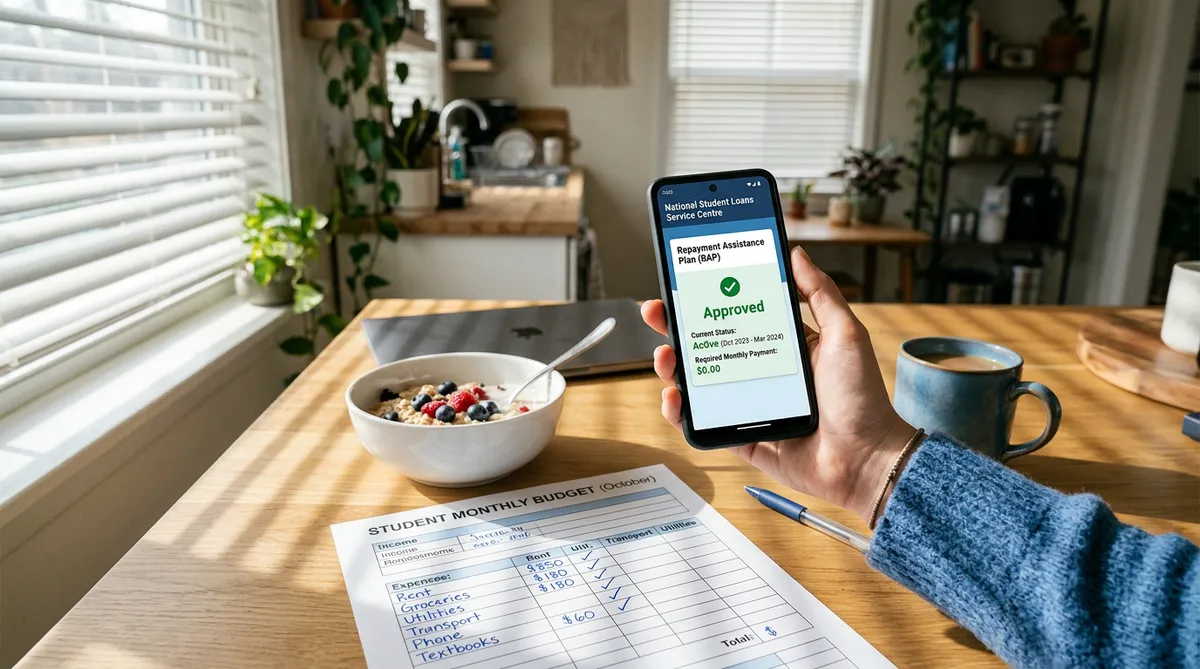
- Log in to your NSLSC account at canlearn.ca or call 1-888-815-4514.
- Complete the RAP application form, which requires your income information.
- If you file taxes through the CRA, you can authorize the NSLSC to verify your income automatically, which speeds up processing.
- Reapply every six months without fail.
Do not wait until you have already missed payments. Apply the moment you realize you cannot make your standard payment. RAP exists to prevent default, but it cannot retroactively fix missed payments that have already been reported to the credit bureaus.
Provincial Programs You Should Know About
OSAP Repayment Assistance (Ontario)
Ontario’s RAP works alongside the federal program. When you apply through the NSLSC, your application is typically assessed for both federal and Ontario assistance simultaneously. Ontario’s program can reduce or eliminate the provincial portion of your payment as well. The income thresholds and terms largely mirror the federal RAP.
BC Repayment Assistance
British Columbia’s program functions similarly. Since BC has also eliminated provincial student loan interest, the combination of federal and BC interest-free loans means BC graduates carry some of the lowest-cost student debt in the country.
Quebec and Other Provinces
Quebec operates its own student loan system entirely separate from the federal program. If you have Quebec student loans, contact Aide financiere aux etudes directly. Other provinces each have their own assistance programs with varying terms and thresholds. Contact your provincial student aid office regardless of which province issued your loans.
Rebuilding Your Credit After Student Loan Damage
If your student loans have already caused credit damage, whether through late payments, default, or CRA collections, recovery is absolutely possible. It requires a deliberate strategy and consistent effort over 12 to 24 months.
Step 1: Stabilize Your Student Loan Situation
Before you focus on rebuilding credit, stop the bleeding. Apply for RAP if you have not already. If your loans are in default with the CRA, contact the NSLSC about rehabilitation options. In some cases, you may be able to bring a defaulted loan back into good standing through a rehabilitation agreement, which involves making a series of consecutive on-time payments.
If your debt situation extends beyond student loans into credit card debt, lines of credit, or other obligations, read our guide on consumer proposals in Canada to understand whether that option makes sense for your total debt picture. A consumer proposal can include student loan debt only if you have been out of school for more than seven years.
Step 2: Start Monitoring Your Credit
You cannot fix what you cannot see. Sign up for free credit monitoring through Borrowell, which gives you weekly access to your Equifax credit score and a full copy of your credit report. Check your report carefully for errors. Student loan servicers sometimes report incorrect information, such as wrong payment dates or balances. If you find errors, our guide on how to dispute credit report errors in Canada walks you through the process step by step. You can also use our free dispute letter template to draft your dispute.
Step 3: Open a Secured Credit Card
A secured credit card is the most reliable tool for rebuilding credit in Canada. You provide a refundable security deposit (typically $75 to $300), which becomes your credit limit. Use the card for one or two small purchases each month and pay the full statement balance by the due date.
Two strong options:
- Capital One Secured Mastercard: No annual fee, reports to both Equifax and TransUnion, and requires a minimum $75 refundable deposit. One of the most accessible options for Canadians with damaged credit.
- KOHO: While primarily a prepaid spending account, KOHO’s Credit Building feature reports to Equifax and can help establish a positive payment history alongside your secured card.
For a detailed comparison of all available options, read our guide to the best secured credit cards in Canada for 2026.
Step 4: Automate Everything
Set up automatic payments for at least the minimum amount on every obligation: student loans, secured credit card, phone bill, everything. A single missed payment can erase months of rebuilding progress. If your bank allows it, set a calendar reminder three days before each due date as a backup.
Step 5: Report Your Rent Payments
Most recent graduates are renters. Services like Chexy and FrontLobby can report your rent payments to the credit bureaus. Since you are already paying rent every month, having those on-time payments reflected on your credit report is essentially free credit building.
Step 6: Keep Debt Utilization Low
If you have a secured credit card with a $300 limit, try to keep your statement balance below $90 (30% of the limit). Credit utilization is the second most important factor in your score after payment history. Lower is better. Below 10% is ideal if you can manage it.
Should You Consolidate Your Student Loans?
Consolidating student loans into a personal line of credit or bank loan is tempting when you see a lower interest rate advertised. However, there are serious trade-offs for Canadian student loan borrowers:
What you gain:
- Potentially a simpler single monthly payment (if you have both federal and provincial loans).
- Fixed repayment schedule with a clear end date.
What you lose:
- Eligibility for RAP. Once you consolidate into a private product, you cannot access government repayment assistance.
- The 15-year forgiveness rule no longer applies.
- The interest-free status of your federal loans. A private consolidation loan will charge interest.
- Protection from CRA wage garnishment rules (which at least have caps). Private creditors can pursue different collection methods.
For most borrowers who are struggling, consolidation is the wrong move. RAP provides more flexibility and safety. Consolidation makes sense only if you have a stable, higher income and want to pay off the debt faster at a genuinely lower total cost, but that scenario rarely applies to someone who is also rebuilding credit.
Use our debt payoff calculator to model different repayment scenarios and see how consolidation compares to staying with your current loan structure.
The Seven-Year Student Loan Rule and Insolvency
If your financial situation is severe enough that you are considering bankruptcy or a consumer proposal, there is an important rule specific to student debt in Canada: student loans are not automatically dischargeable in bankruptcy or a consumer proposal unless you have been out of school for at least seven years. This is measured from the date you ceased to be a full-time or part-time student.
If it has been fewer than seven years, you can still file for bankruptcy or a consumer proposal, but your student loan debt will survive the process and you will still owe it afterward. After the seven-year mark, student loans are treated the same as other unsecured debts.
In cases of hardship, a court can reduce the waiting period to five years, but this requires a separate application and is granted at the court’s discretion.
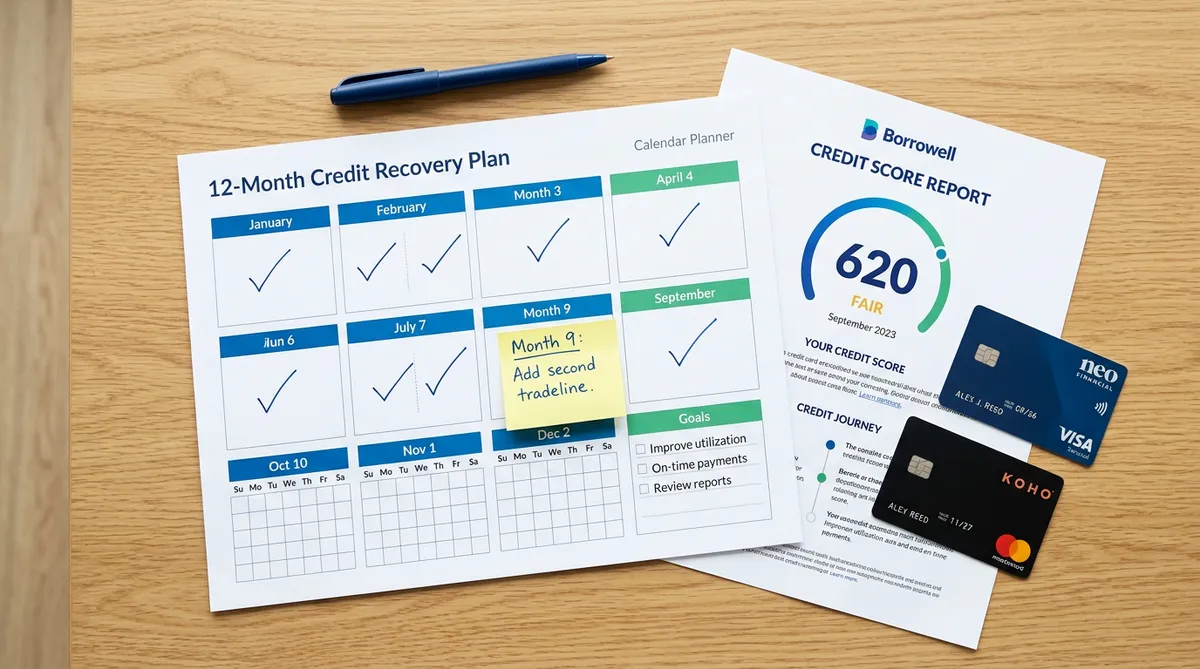
12-Month Credit Recovery Timeline
Here is a realistic timeline for rebuilding your credit after student loan damage:
Months 1-2: Foundation
- Check your credit score and report through Borrowell.
- Apply for RAP if you are behind on payments or at risk of falling behind.
- Open a secured credit card and begin using it for one small recurring purchase.
- Update your address with the NSLSC to ensure you receive all correspondence.
Months 3-4: Build Momentum
- Maintain perfect payment history on all accounts.
- Set up rent reporting.
- Use the KOHO Credit Building feature for an additional positive tradeline on your report.
- Dispute any errors you found on your credit report using our dispute letter tool.
Months 5-8: Consistency
- Continue on-time payments across all accounts. This is the period where your score begins to recover noticeably.
- Reapply for RAP at the six-month mark. Do not miss this deadline.
- Keep credit utilization below 30% on your secured card.
Months 9-12: Acceleration
- Your score should be measurably higher if you have maintained perfect payments. Many borrowers see a 50 to 120 point improvement in this timeframe.
- Consider whether you qualify for an unsecured credit card or a credit limit increase on your secured card.
- Revisit your student loan repayment strategy. If your income has increased, you may be able to exit RAP and make standard payments.
Take our credit recovery quiz to see a personalized version of this timeline based on your specific situation, income, and current score.
When to Get Professional Help
If your student debt situation involves any of the following, consider speaking with a Licensed Insolvency Trustee (LIT) or a non-profit credit counsellor accredited by Credit Counselling Canada:
- Your total debts (student loans plus everything else) exceed your annual gross income.
- The CRA is already garnishing your wages or intercepting your tax refunds.
- You have been out of school for more than seven years and your student debt is part of a larger unmanageable debt picture.
- You are considering bankruptcy and want to understand how it would affect your student loans specifically.
Non-profit credit counselling is free. Be wary of for-profit debt settlement companies that charge large upfront fees.
Frequently Asked Questions
Do student loan payments under RAP count as on-time payments on my credit report?
Yes. When you are enrolled in RAP through the NSLSC and your required payment is reduced (even to zero dollars), those payments are reported as on-time to both Equifax and TransUnion. RAP is not a deferral or forbearance in the traditional sense. It is a government-approved repayment arrangement, and it does not create negative marks on your credit report. This is one of the strongest reasons to apply for RAP early rather than simply missing payments.
Can the CRA garnish my wages for student loan debt without taking me to court?
Yes. The Canada Revenue Agency has extraordinary collection powers that private creditors do not have. Once your federal student loans are in default (after approximately nine months of non-payment) and transferred to the CRA for collection, the CRA can garnish up to 50% of your wages, seize your income tax refunds, intercept your GST/HST credits, and redirect your Canada Child Benefit payments, all without obtaining a court order. This is why preventing default through RAP or other assistance programs is so important.
Are federal Canada Student Loans still interest-free in 2026?
Yes. As of April 1, 2023, the federal government permanently eliminated interest on Canada Student Loans and Canada Apprentice Loans. This applies to all borrowers regardless of income or repayment status. However, this only covers the federal portion of your student loan. Provincial student loans may still carry interest depending on your province. Ontario, Alberta, and several other provinces still charge interest on the provincial portion, while British Columbia and Nova Scotia have eliminated provincial interest as well.
What happens to my student loans if I file for bankruptcy in Canada?
Student loans receive special treatment under Canadian insolvency law. If you have been out of school for fewer than seven years, your student loan debt survives a bankruptcy or consumer proposal. You will still owe the full amount after the process is complete. Once seven years have passed since you were last a student, student loans can be included in a bankruptcy or consumer proposal and discharged along with your other debts. In cases of proven hardship, a court may reduce this period to five years, but approval is not guaranteed.
How long does it take to rebuild my credit score after student loan default?
The default record remains on your Canadian credit report for six to seven years from the date of last activity, depending on the province. However, you do not need to wait that long for your score to recover meaningfully. Most borrowers who follow a consistent rebuilding strategy (secured credit card, on-time payments, RAP enrollment, rent reporting) see significant score improvement within 12 to 18 months. The negative mark will still be visible on your report, but its impact on your score diminishes over time as you build a stronger recent payment history. The key is that new positive information gradually outweighs the old negative information.
This article contains affiliate links to financial products including Borrowell, KOHO, and Capital One. If you sign up through these links, we may earn a commission at no extra cost to you. We only recommend products we have researched and believe can genuinely help Canadians rebuild their credit. Our editorial content is not influenced by affiliate partnerships. See our full affiliate disclosure for details.
Get Your Personalized Recovery Plan
Answer 6 quick questions and get a step-by-step plan tailored to your situation.
Take the Free Quiz Product manager in fintech, immigrant to Canada, and founder of Credit Score Hero. I moved from Kyrgyzstan to Montreal in 2022 and built this site to help Canadians navigate the credit system with free tools and honest, Canada-specific advice.
Related Recovery Guides
After Bankruptcy
Month-by-month recovery plan for Canada
After Divorce
How to recover your credit after separation
After Payday Loans
Rebuilding credit after the payday loan trap
Best Secured Cards 2026
Compare secured credit cards for rebuilding in Canada
Renting with Bad Credit (Ontario)
Your rights as a renter under the Human Rights Code