Consumer Proposals in Canada: Credit Impact + Recovery
Everything Canadians need to know about consumer proposals: how they work, how they affect your credit score, R7 vs R9 ratings, timeline for removal, and how to rebuild after completion.

Product Manager in Fintech · Montreal, Canada
Ready to start recovering? Our free quiz creates a personalized plan for your exact situation.
Take the Free Quiz →A Uniquely Canadian Path Out of Debt
If you are drowning in debt and the word “bankruptcy” makes your stomach drop, there is something you should know: Canada offers a powerful legal alternative that does not exist in the United States or most other countries. It is called a consumer proposal, and it allows you to negotiate with your creditors to repay only a portion of what you owe, typically between 30 and 70 cents on the dollar, while keeping your assets and avoiding the full severity of bankruptcy on your credit report.
Consumer proposals now outnumber personal bankruptcies in Canada by a wide margin. They have become the most common formal insolvency filing in the country. This guide covers how the process works, exactly how it affects your credit score, how long it stays on your report, and how to rebuild once it is complete.
 Not sure where you stand? Take our recovery quiz for a personalized starting point.
What Is a Consumer Proposal?
A consumer proposal is a formal, legally binding agreement between you and your creditors. It is governed by the Bankruptcy and Insolvency Act (BIA), the same federal legislation that governs personal bankruptcy in Canada. However, a consumer proposal is not bankruptcy. That distinction matters enormously, both legally and in terms of your credit.
Here is how the process works:
- You meet with a Licensed Insolvency Trustee (LIT). This is a professional regulated by the Office of the Superintendent of Bankruptcy, a branch of the federal government. Only an LIT can administer a consumer proposal. Your initial consultation is typically free.
- The LIT assesses your situation and drafts a formal offer to your creditors, specifying how much you will pay back (usually 30 to 70 percent of your total unsecured debt) over up to five years.
- Creditors vote. Your creditors have 45 days to accept or reject the proposal. Creditors holding a majority of the dollar value of your debt must vote in favour. If they do not respond within 45 days, they are deemed to have accepted.
- You make payments. Once accepted, you make regular monthly payments to your LIT, who distributes the funds to your creditors. Interest stops accumulating on all included debts from the moment you file.
- You complete the proposal. Once you have made all required payments and attended two mandatory financial counselling sessions, the remaining debt is legally forgiven.
What Debts Can Be Included?
A consumer proposal can cover most unsecured debts, including:
- Credit card balances
- Personal loans and lines of credit
- Payday loans
- CRA income tax debt
- Student loans (if you have been out of school for more than seven years)
- Medical bills and other unsecured obligations
It cannot be used for secured debts like your mortgage or a car loan where the lender holds a lien on the asset. There is also a maximum debt limit of $250,000 (excluding your mortgage). If your unsecured debts exceed that threshold, you would need a Division I proposal instead.
Consumer Proposal vs Bankruptcy: A Direct Comparison
Here is how they compare across the factors that matter most.
| Factor | Consumer Proposal | Bankruptcy |
|---|---|---|
| Credit rating | R7 on included accounts | R9 on included accounts (worst possible) |
| Time on credit report | 3 years after completion | 6 years after discharge (first bankruptcy) |
| Your assets | You keep all your assets | Non-exempt assets may be seized and sold |
| Cost | Pay a negotiated portion (30-70%) of your debt | Pay what the trustee determines based on income and assets |
| Duration of process | Up to 5 years of payments | 9 months (first-time, no surplus) to 21 months |
| Surplus income | Not applicable; fixed monthly payment | Required to pay 50% of income above a threshold |
| Legal protection | Creditors cannot pursue you once filed | Creditors cannot pursue you once filed |
Both options provide a stay of proceedings, meaning creditors must immediately stop collection calls, wage garnishments, and legal actions once you file. Both require working with an LIT and both significantly affect your credit score, but the severity and duration differ.
For a deeper dive into the bankruptcy side, read our guide on how long bankruptcy stays on your credit report in Canada.
What I See at Work Every Week
I work as a product manager at a financial company in Montreal, and I have seen the numbers firsthand. Roughly 30 to 40 percent of Canadians carry credit scores below 600. Many ended up there after a bankruptcy, and the aftermath is harsh — traditional banks will not touch them. They end up borrowing through payday lenders at 400% APR because no one else will extend credit. A consumer proposal, while still damaging to your score, puts you in a fundamentally different recovery position. The people I have seen choose this route consistently rebuild faster and spend less in total interest over the following years.
When I moved to Canada from Kyrgyzstan in 2022, the whole concept of consumer proposals was completely foreign to me. Back home, the credit system works differently. And most “credit recovery” advice online is actually written for Americans dealing with Chapter 7 or Chapter 13 — neither of which exists in Canada. A consumer proposal is a distinctly Canadian legal tool. Understanding it properly matters if you live here, and confusing it with American bankruptcy procedures can lead you to make the wrong financial decision.
How a Consumer Proposal Affects Your Credit Score
The impact on your credit score unfolds in three distinct phases.
Phase 1: The Immediate Impact
When you file a consumer proposal, every unsecured credit account included in the proposal is assigned an R7 rating by the credit bureaus. On the Canadian credit rating scale, R1 is the best (paid as agreed) and R9 is the worst (bankruptcy or bad debt placed for collection). An R7 means the account is being repaid through a special arrangement with creditors.
Your credit score will drop significantly, typically into the 400-500 range after filing. If your score was already low due to missed payments and collections, the additional drop may be modest. The consumer proposal is also recorded as a separate entry in the public records section of your credit report.
Phase 2: During the Proposal
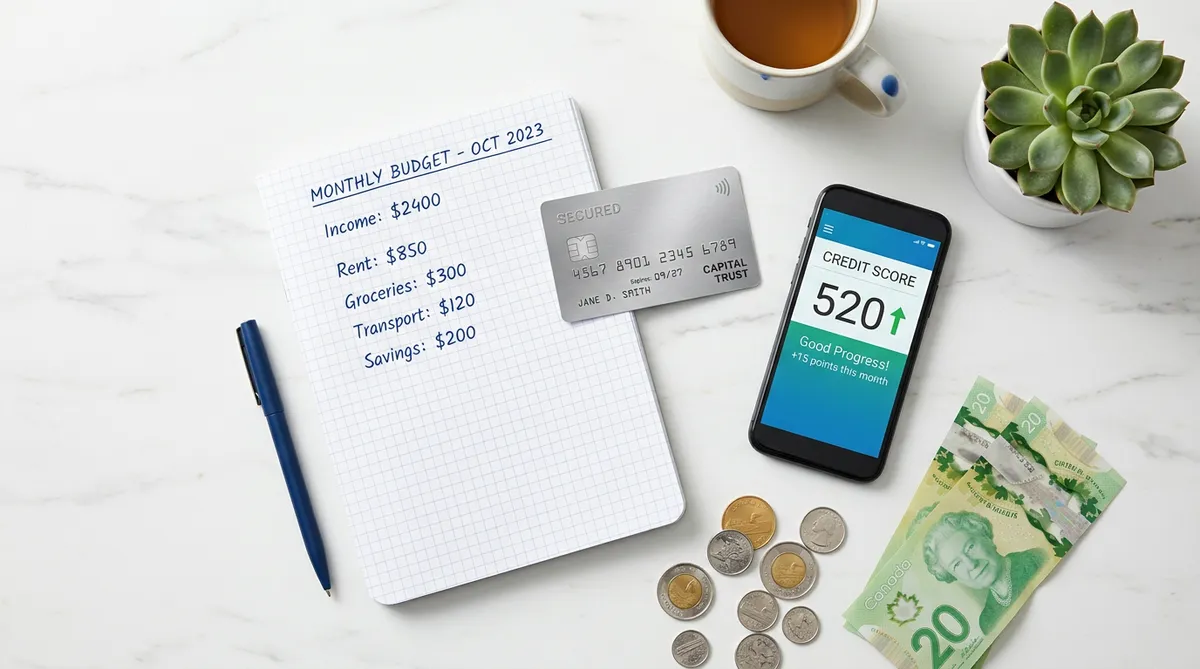
While your proposal is active, credit options are limited and the R7 ratings remain in place. Your score will stay low, typically in the 400-550 range. However, this phase is not dead time. You can apply for new credit while your proposal is active, and we cover the strategy in detail below.
Phase 3: After Completion
Once you have completed all payments and received your Certificate of Completion, the countdown begins for the R7 notation to be removed from your credit report. The proposal is marked as completed, and while it remains on your report for a period after that, its impact on your score diminishes over time, especially as you add new positive credit history.
The day the consumer proposal notation drops off your report entirely, you may see an immediate score increase of 50 to 100 points or more.
Timeline: How Long Does a Consumer Proposal Stay on Your Credit Report?
The two major credit bureaus in Canada handle the timeline slightly differently.
Equifax Canada
Equifax removes the consumer proposal notation 3 years after you complete all payments, or 6 years from the date you filed, whichever comes first.
TransUnion Canada
TransUnion removes the notation 3 years after completion of the proposal.
A Practical Example
Suppose you file in March 2026 and complete payments by March 2030 (a four-year proposal). Equifax would remove the notation by the earlier of March 2033 or March 2032, so it disappears in March 2032. TransUnion removes it in March 2033 (three years after completion).
Now consider a faster scenario. You file in March 2026 and make lump-sum payments to complete the proposal by March 2028. Equifax removes the notation by the earlier of March 2031 or March 2032, so it disappears in March 2031. TransUnion also removes it in March 2031.
The takeaway: completing your proposal faster means the notation disappears sooner. If you receive a bonus, tax refund, or other windfall, putting it toward a lump-sum payment shortens the total reporting period.
Use our calculator to estimate your personal timeline based on your filing and completion dates.
Rebuilding Credit During and After a Consumer Proposal
You do not have to wait until the consumer proposal is off your report to start rebuilding. In fact, the sooner you begin, the stronger your credit will be once the notation finally disappears.
Rebuilding During Your Proposal
You can obtain new credit while a consumer proposal is active. You are required to disclose the proposal to any lender and must not take on debt greater than $1,000 without informing your trustee.
The most effective tool is a secured credit card, which requires a refundable deposit that acts as your credit limit. The Capital One Secured Mastercard is one of the most accessible options in Canada, with a minimum deposit starting at $75. Use it for one small recurring purchase each month, keep utilization below 30 percent, and pay the full balance by the due date every time. This builds a new positive tradeline that begins counteracting the R7 ratings.
For day-to-day spending, consider a prepaid card like KOHO to manage your money without overdraft risk while you focus on proposal payments.
Rebuilding After Completion: A Month-by-Month Plan
Once you receive your Certificate of Completion, your rebuilding efforts can accelerate. Here is a practical timeline.
Months 1-2: Verify and Monitor
Pull your credit reports from both Equifax and TransUnion. Sign up for Borrowell for free weekly Equifax score updates. Confirm that all included debts show a zero balance and that the proposal is marked as completed, not still active. Dispute any errors immediately with the relevant bureau.
Months 3-4: Strengthen Your Credit Foundation
If you already have a secured card from during your proposal, continue using it with perfect payment habits. If you do not have one yet, apply for the Capital One Secured Mastercard now. Consider increasing your secured deposit to raise your limit and improve your utilization ratio.
Months 5-8: Build Consistency
Maintain flawless payment history on your secured card. Do not apply for additional products yet. Monitor your score monthly through Borrowell. You should begin seeing meaningful upward movement during this period. Resist the temptation to apply for multiple cards. Each application generates a hard inquiry that costs a few points.
Months 9-12: Diversify Your Credit Mix
Apply for a second credit product. This could be a credit-builder loan from a credit union, a second secured card from a different issuer, or a small RRSP loan. Having two active accounts reporting on-time payments is significantly better than one. After 12 months of perfect payments, ask your card issuer about upgrading to an unsecured card and refunding your deposit.
Months 13-24: Accelerate
Target a score of 650 or higher. You may now qualify for an unsecured credit card with modest rewards. Consider reporting your rent payments to the credit bureaus for an additional positive tradeline. Set your sights on 680+, which opens the door to competitive interest rates on car loans and begins positioning you for mortgage qualification.
For a more detailed version of this rebuilding strategy, read our complete post-bankruptcy rebuilding guide. The steps are the same whether you are coming out of a consumer proposal or a bankruptcy.
Should You File a Consumer Proposal?
A consumer proposal is a powerful tool, but it is not the right solution for everyone. Here is when it typically makes sense and when it does not.
It May Be Right If:
- You have significant unsecured debt ($10,000+) that you cannot realistically repay in full.
- You have a stable income for regular monthly payments over up to five years.
- You want to keep your assets. Unlike bankruptcy, a consumer proposal does not put your home, vehicle, or investments at risk.
- You owe money to the CRA. Consumer proposals can include income tax debt, which can otherwise be very aggressive to collect.
- You want to avoid the R9 rating that comes with bankruptcy in favour of the less severe R7.
It May Not Be Right If:
- Your debts are manageable with a revised budget or a debt consolidation loan. A consumer proposal should not be your first resort.
- You have very little income and cannot afford even reduced monthly payments. Bankruptcy may provide faster relief.
- Your unsecured debts exceed $250,000 (excluding your mortgage). You would need a Division I proposal instead.
- You have only one or two small debts. Negotiating directly with the creditor or working with a non-profit credit counselling agency may be more appropriate.
If you are unsure, talk to a Licensed Insolvency Trustee. The consultation is free, and they are legally obligated to present all of your options.
How to Find a Licensed Insolvency Trustee
Licensed Insolvency Trustees are the only professionals in Canada legally authorized to administer consumer proposals and bankruptcies. They are regulated by the Office of the Superintendent of Bankruptcy, part of the federal government. The OSB maintains a public directory of all licensed trustees at ic.gc.ca where you can search by province and city.
Most LITs offer a free initial consultation with no obligation to file. The fees for a consumer proposal are standardized by legislation (the trustee is paid from the funds you pay into the proposal, not separately by you), but the quality of service can vary, so consider meeting with two or three before deciding.
Be wary of debt consultants or companies that charge upfront fees to refer you to a trustee. You do not need a middleman. Go directly to an LIT.
Frequently Asked Questions
Can creditors reject my consumer proposal?
Yes, creditors have 45 days to vote, and those holding a majority of the dollar value of your debt must vote in favour. In practice, most proposals are accepted because creditors typically recover more than they would from a bankruptcy. If rejected, your LIT can help you revise the terms and resubmit.
Does a consumer proposal affect my spouse?
A consumer proposal is an individual filing. It does not appear on your spouse’s credit report unless they were a co-borrower or guarantor on an included debt. If you had joint debts, your spouse remains responsible for the full balance and creditors may pursue them for payment.
Can I pay off my consumer proposal early?
Yes, and it is a smart strategy. There is no penalty for making lump-sum payments to complete your proposal ahead of schedule. Finishing early means the three-year clock for removal starts sooner. If you receive a tax refund, bonus, or other windfall, consider putting it toward your proposal.
Will a consumer proposal stop wage garnishments?
Yes. Once you file, a stay of proceedings takes effect immediately, legally preventing creditors from continuing or initiating wage garnishments, lawsuits, or collection calls related to included debts. The stay remains in place as long as your proposal is active and you are making payments.
Moving Forward
Filing a consumer proposal is not a sign of failure. It is a legal tool designed to help Canadians regain control of their finances when debt has become unmanageable. Thousands of people file every year, and the vast majority rebuild their credit successfully within a few years of completion.
Check your credit report through Borrowell to see where you stand today. Take our recovery quiz for a personalized rebuilding plan. And if you are weighing a consumer proposal against bankruptcy, read our guide on how long bankruptcy stays on your credit report in Canada for a clear comparison of the timelines.
Your credit score is not permanent. It reflects your most recent financial behaviour, and with the right strategy, it will recover.
Get Your Personalized Recovery Plan
Answer 6 quick questions and get a step-by-step plan tailored to your situation.
Take the Free Quiz Product manager in fintech, immigrant to Canada, and founder of Credit Score Hero. I moved from Kyrgyzstan to Montreal in 2022 and built this site to help Canadians navigate the credit system with free tools and honest, Canada-specific advice.
Related Recovery Guides
After Divorce
How to recover your credit after separation
Student Debt Recovery
Guide for Canadians with student debt problems
After Payday Loans
Rebuilding credit after the payday loan trap
Best Secured Cards 2026
Compare secured credit cards for rebuilding in Canada
Renting with Bad Credit (Ontario)
Your rights as a renter under the Human Rights Code