Credit Score Needed for a Mortgage in Canada (2026)
Learn the minimum credit score needed for a mortgage in Canada. A-lenders, B-lenders, and private lenders explained, plus CMHC insurance rules and how to improve your score before applying.

Product Manager in Fintech · Montreal, Canada
Ready to start recovering? Our free quiz creates a personalized plan for your exact situation.
Take the Free Quiz →The Quick Answer: Credit Score Requirements by Lender Type
If you are trying to figure out whether your credit score is high enough to get a mortgage in Canada, here is the simplified breakdown:
| Credit Score Range | Lender Type | Typical Interest Rate | Minimum Down Payment |
|---|---|---|---|
| 750+ | A-lender (Big 5 banks, credit unions) | Best available (~4.5-5.2%) | 5% with CMHC insurance |
| 680-749 | A-lender (most approvals) | Competitive (~4.8-5.5%) | 5% with CMHC insurance |
| 620-679 | Some A-lenders with CMHC insurance, B-lenders more favorable | 5-6.5% | 5-20% depending on lender |
| 550-619 | B-lender territory | 6-9% | 20% typically required |
| Below 550 | Private lender only | 8-15% | 20%+ required |
These are general guidelines for 2026. Your actual rate depends on your full financial picture, but your credit score is the first gate that determines which category of lender will work with you.
Not sure where you stand? Check your credit score for free through Borrowell before you start shopping for a mortgage. Knowing your number is the first step in any homebuying plan.
My Hard Inquiry Mistake Cost Me 20 Points During My Home Purchase
When I bought my first house in Canada, my credit score was around 750 — solid enough for A-lender territory. But I made an expensive mistake during the process. I wanted to buy a fridge and tried to finance it through CitiBank at the appliance store. They ran a hard inquiry, I waited three weeks for an answer, and they declined me anyway. My score dropped 20 points overnight. If I had known how hard inquiries worked, I would have just paid cash for the fridge and kept those points. Twenty points might not sound like much, but when you are right on the edge of a rate tier, it can mean thousands of dollars over a 25-year mortgage.
I also applied for a credit line through Scotia Bank around the same time and got rejected — they said I had not been in Canada long enough. I moved here from Kyrgyzstan in 2022, and even though I had a stable product manager salary and a 750 score, some lenders still treated me as higher risk because of my limited Canadian credit history. That experience taught me something important: your credit score gets you in the door, but lenders look at the full picture, and time in country matters more than many newcomers expect.

A-Lenders: The Big 5 Banks and Credit Unions
A-lenders are the traditional mortgage providers in Canada. This group includes the Big 5 banks (RBC, TD, BMO, Scotiabank, and CIBC), other national banks, and most major credit unions. These lenders offer the lowest interest rates and most favorable terms.
What Score Do You Need?
Most A-lenders want a minimum credit score of 680 for their best rates. At 680 and above, you are a low-risk borrower with access to the most competitive fixed and variable rate options.
If your score falls between 620 and 679, you may still qualify with an A-lender, but typically only for a CMHC-insured mortgage (meaning your down payment is less than 20%). The mortgage insurance protects the lender, which makes them more willing to work with a slightly lower score. Expect a rate 0.25% to 0.5% above what a 720-score borrower would receive.
Below 620, most A-lenders will decline your application. This is where B-lenders enter the picture.
What Rates Can You Expect?
In 2026, competitive five-year fixed rates from A-lenders generally fall in the 4.5% to 5.5% range for well-qualified borrowers. Variable rates fluctuate with the Bank of Canada’s policy rate.
Credit unions sometimes offer more flexible underwriting than the Big 5 banks. If your score is in the low 680s and a major bank has turned you down, a local credit union is worth exploring before moving to a B-lender.
B-Lenders: Alternative Mortgage Lenders
B-lenders are federally or provincially regulated lenders that specialize in borrowers who do not fit the A-lender mold. Names like Home Trust, Equitable Bank, CMLS Financial, and First National are well-known in this space.
Who Qualifies?
B-lenders typically work with borrowers whose credit scores fall in the 550 to 679 range. They are more flexible on credit blemishes, self-employment income, and non-traditional down payment sources. If you have a completed consumer proposal or some late payments but have been rebuilding steadily, a B-lender may be your best realistic option.
What Does It Cost?
The trade-off for that flexibility is a higher interest rate and often a shorter mortgage term. Expect rates in the 6% to 9% range, and most B-lender mortgages are offered as one- or two-year terms rather than the standard five-year term you would get from a big bank. You will also typically need a 20% down payment, since CMHC insurance is generally not available for B-lender mortgages when the borrower’s score is below 600.
There is also typically a lender fee of 1% of the mortgage amount, added to the cost of borrowing.
The higher rate makes a significant difference over time. On a $400,000 mortgage, the difference between a 5% rate and a 7.5% rate works out to roughly $500 more per month. Use our cost of bad credit calculator to see exactly how much a lower score could cost you on your specific mortgage amount.
The good news is that B-lender mortgages are designed to be temporary. The goal is to use the one- or two-year term to continue improving your credit, then refinance with an A-lender at a much better rate when your term is up.
Private Lenders: The Last Resort
Private lenders are individuals or companies that lend their own money and are not regulated like banks. There is no minimum credit score requirement for a private mortgage. If you have a large enough down payment and the property secures the loan, a private lender may fund you regardless of your credit history.
What Does It Cost?
Private mortgage rates typically range from 8% to 15%, with lender fees of 2% to 5% of the mortgage amount. Terms are almost always one year. If you cannot refinance or sell when the term expires, you risk losing your home.
Private lending should only be considered when you have a clear plan to transition to a B-lender or A-lender within 12 to 24 months. Make sure you fully understand the total cost of borrowing and have a realistic exit strategy.
CMHC Mortgage Insurance: What You Need to Know
In Canada, if your down payment is less than 20% of the purchase price, you must purchase mortgage default insurance from CMHC (Canada Mortgage and Housing Corporation), Sagen, or Canada Guaranty. It protects the lender, not you, but you pay the premiums.
Minimum Score for CMHC Insurance
CMHC requires a minimum credit score of 600 for insurance approval. At least one borrower on the application must meet this threshold.
In practice, most CMHC-insured mortgages are approved at scores of 620 and above. Between 600 and 619, approval is possible but the lender will scrutinize your application more closely.
What Does CMHC Insurance Cost?
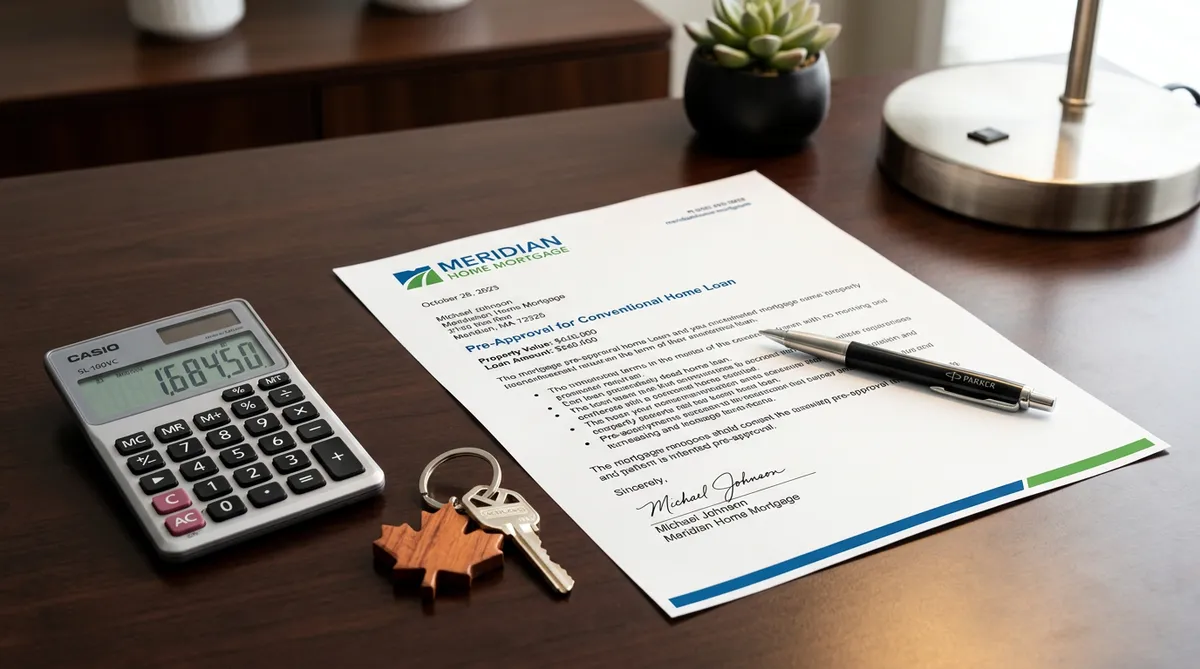
The insurance premium is calculated as a percentage of the mortgage amount, based on your loan-to-value ratio:
| Down Payment | CMHC Premium (% of mortgage) |
|---|---|
| 5% (up to $500,000 of purchase price) | 4.00% |
| 10% | 3.10% |
| 15% | 2.80% |
On a $500,000 home with 5% down ($25,000), the CMHC premium would be $19,000 (4.00% of your $475,000 mortgage). This amount is usually added to the mortgage balance and paid off over the life of the loan.
While the premium is significant, CMHC insurance gives you access to A-lender rates with a much smaller down payment. For many first-time buyers, the math works out better than saving for 20% down.
Note that CMHC-insured mortgages are only available for properties priced at $1.5 million or less. Above that threshold, you need a minimum 20% down payment.
Beyond Your Credit Score: What Else Mortgage Lenders Assess
Your credit score opens the door, but lenders evaluate several other factors before approving your application.
Gross Debt Service (GDS) Ratio
Your GDS ratio measures how much of your gross monthly income goes toward housing costs, including your mortgage payment, property taxes, heating, and 50% of condo fees if applicable. Most lenders want your GDS ratio to be 39% or less.
Total Debt Service (TDS) Ratio
Your TDS ratio adds all other monthly debt obligations (car loans, credit card minimums, student loans, lines of credit) to your housing costs. Lenders typically want this number at 44% or less.
If your ratios are too high, the lender may approve you for a smaller mortgage amount or decline your application entirely. Paying down existing debt before applying for a mortgage can dramatically improve your ratios.
Income Verification
A-lenders require standard documentation: recent pay stubs, T4 slips, and an employment letter for salaried workers. Self-employed borrowers typically need two years of Notices of Assessment from CRA and business financial statements. B-lenders may accept stated income, which is one reason self-employed Canadians often end up in B-lender territory even with decent credit scores.
Down Payment Source
Lenders verify that your down payment comes from a legitimate source: personal savings, RRSPs withdrawn under the Home Buyers’ Plan (up to $60,000), gifts from immediate family (with a signed gift letter), or proceeds from selling another property. Borrowed down payments are generally not accepted for insured mortgages.
The Mortgage Stress Test
Every borrower in Canada must pass the federal mortgage stress test, enforced by the Office of the Superintendent of Financial Institutions (OSFI). You must qualify at the higher of your contract rate plus 2%, or the 5.25% qualifying rate floor.
For example, if a lender offers you a rate of 5%, you must demonstrate you can afford payments at 7%. This reduces the maximum mortgage you can be approved for by roughly 15% to 20% compared to qualifying at the actual contract rate.
The stress test applies to A-lenders and B-lenders alike. Private lenders are not subject to OSFI rules, but responsible private lenders often apply their own affordability assessments.
How to Improve Your Credit Score Before Applying for a Mortgage
If your score is not where it needs to be, the good news is that credit scores respond relatively quickly to positive changes. Here is a practical plan for getting mortgage-ready.
Step 1: Know Your Starting Point
Pull your credit report and check your score. Borrowell gives you free weekly Equifax score updates and alerts you to changes on your report. Take our recovery quiz to get a personalized action plan based on your specific situation.
Step 2: Dispute Any Errors
Roughly one in five credit reports contain errors. Look for accounts that are not yours, incorrect balances, or debts that should have been removed. Dispute errors directly with Equifax Canada and TransUnion Canada. Correcting a single error can boost your score by 20 to 50 points.
Step 3: Pay Down Credit Card Balances
Credit utilization accounts for about 30% of your score. Aim to get every card below 30% utilization, and ideally below 10%. Paying down a card from 80% utilization to 30% could boost your score significantly within one to two billing cycles.

Step 4: Make Every Payment on Time
Payment history is the single largest factor at 35% of your score. Set up automatic payments for every bill. Even one missed payment can drop your score by 50 to 100 points and stay on your report for six years.
Step 5: Avoid New Credit Applications
In the six to twelve months before applying for a mortgage, avoid applying for new credit cards, car loans, or other financing. The exception is mortgage rate shopping, where multiple inquiries within a 14-day window are treated as a single inquiry.
Step 6: Build Thin Credit Files
If you have fewer than two active credit accounts, consider adding a secured credit card. The Capital One Secured Mastercard is a solid starting point. Even one additional account reporting on-time payments can improve a thin profile.
Realistic Timelines
How quickly you can raise your score depends on your starting point:
- From 550 to 620: Typically 6 to 12 months with consistent effort.
- From 620 to 680: Typically 3 to 9 months if your main issues are utilization and a few late payments.
- From 680 to 750: Typically 6 to 18 months, as gains become more incremental at higher scores.
These timelines assume consistent effort. Major negative items like bankruptcies take longer. If you are recovering from bankruptcy, our rebuilding credit after bankruptcy guide provides a detailed month-by-month plan.
What to Do If Your Score Is Too Low Right Now
If you are not mortgage-ready today, that does not mean homeownership is off the table. It means you need a plan and a realistic timeline.
If Your Score Is Below 550
Focus on stabilizing your finances first. This might mean resolving collections accounts, completing a consumer proposal, or establishing consistent payment habits over 12 to 18 months. Start saving aggressively for a down payment at the same time. Aim for at least 10% to 15% so you have flexibility when your score improves.
If Your Score Is Between 550 and 620
Getting a mortgage right now is technically possible with 20% down through a B-lender, but the high rates mean you will pay tens of thousands more over the life of the loan. If you can wait 6 to 12 months and push your score above 680, you will save significantly.
If Your Score Is Between 620 and 679
You are close. Focus on quick wins: reducing utilization below 30%, keeping every payment on time, and avoiding new credit applications. A few months of discipline could push you above 680 and save you thousands in interest.
Use our cost of bad credit calculator to see the exact dollar difference between getting a mortgage at your current score versus waiting until you reach A-lender territory.
Frequently Asked Questions
Can I get a mortgage with no credit history in Canada?
Having no credit history is different from having bad credit, but it presents similar challenges. Most A-lenders require at least two active credit accounts with two years of history. If you are new to Canada, start by opening a secured credit card and building 12 to 24 months of payment history. Some credit unions are more flexible with newcomers and may consider alternative credit history such as rent and utility payments.
Does getting pre-approved hurt my credit score?
A mortgage pre-approval involves a hard inquiry, which can temporarily reduce your score by a few points. However, if multiple lenders pull your credit within a 14-day window, the scoring models generally treat those inquiries as a single event. The benefits of knowing your pre-approved amount far outweigh the minor score impact.
Should I use a mortgage broker or go directly to my bank?
A mortgage broker has access to dozens of lenders and can find the best product for your situation. This is especially valuable if your credit is not perfect, because a broker knows which B-lenders are most likely to approve your application. There is generally no cost to you, as brokers are paid by the lender. For borrowers with credit challenges, a broker is almost always the better choice.
How long after a consumer proposal can I get a mortgage?
A consumer proposal stays on your report for three years after completion or six years after filing, whichever comes first. Most A-lenders want the proposal removed and a re-established score above 680. Some B-lenders will consider applications as soon as two years after completion. Check our guide on recovering from a consumer proposal for a step-by-step plan.
Your credit score plays a central role in what homeownership will cost you. Whether you are above 750 or working your way up from 500, understanding your options puts you in control. Start by checking your free credit score, take our personalized recovery quiz, and build your plan from there.
Get Your Personalized Recovery Plan
Answer 6 quick questions and get a step-by-step plan tailored to your situation.
Take the Free Quiz Product manager in fintech, immigrant to Canada, and founder of Credit Score Hero. I moved from Kyrgyzstan to Montreal in 2022 and built this site to help Canadians navigate the credit system with free tools and honest, Canada-specific advice.