Borrowell vs Credit Karma Canada: Which Is Better?
Compare Borrowell and Credit Karma Canada side by side. Which free credit score is more accurate? Learn the difference between Equifax and TransUnion scores and which one Canadian lenders actually use.

Product Manager in Fintech · Montreal, Canada
Ready to start recovering? Our free quiz creates a personalized plan for your exact situation.
Take the Free Quiz →Why Your Credit Score Is Different on Borrowell and Credit Karma
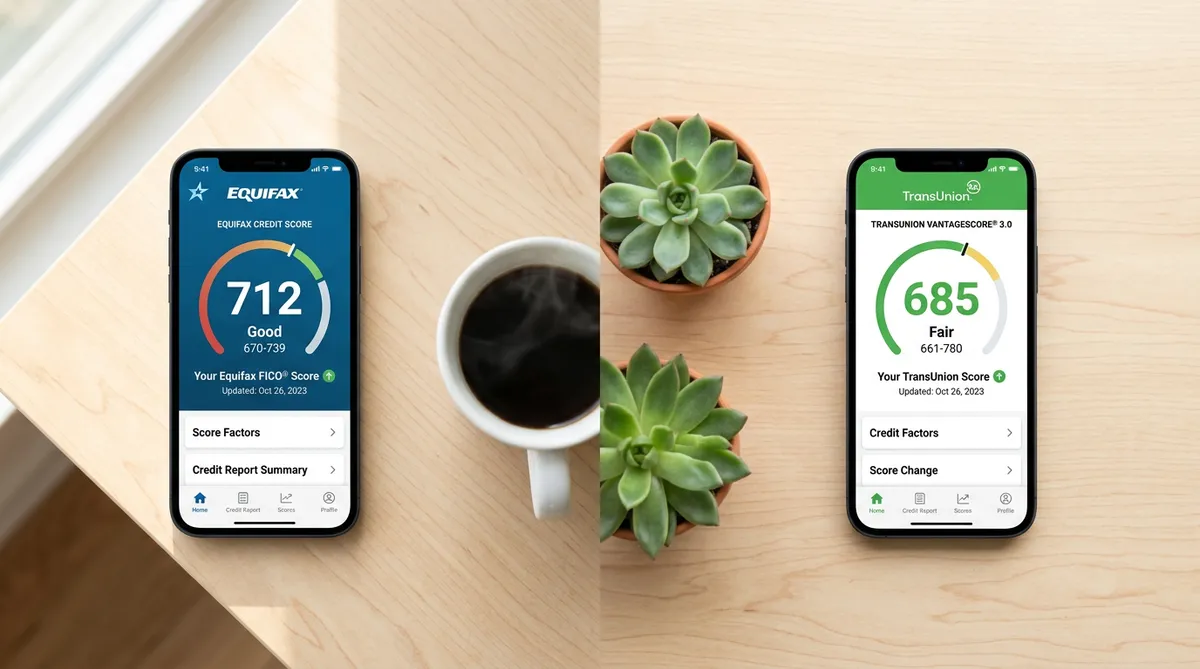
You sign up for Borrowell, check your score, and see 712. Then you open Credit Karma, and it says 685. Naturally, you start to wonder which one is wrong. Maybe both are wrong. Maybe the whole system is broken.
Take a breath. Neither score is wrong. They are simply pulling from two completely different sources, and understanding why they differ is one of the most practical things you can learn about credit in Canada.
In this guide, we will walk through exactly what each platform shows you, why the numbers rarely match, and which score Canadian lenders actually rely on when they review your application.
The Core Difference: Equifax vs TransUnion
The single most important thing to understand is this: Borrowell and Credit Karma pull your credit information from different credit bureaus.
Borrowell provides your credit score and report from Equifax Canada. When you log into Borrowell, every data point you see, your score, your accounts, your payment history, comes from your Equifax file.
Credit Karma Canada provides your credit score and report from TransUnion Canada. Everything you see in Credit Karma is sourced from your TransUnion file.
Canada has two major credit bureaus, Equifax and TransUnion, and they operate independently. Each bureau collects data from lenders, creditors, collection agencies, and public records. But they do not share data with each other. A lender that reports your payment activity to Equifax may or may not also report to TransUnion. The result is that your file at each bureau can contain slightly different information, which produces different scores.
This is not a flaw in the system. It is simply how credit reporting works in Canada. Both scores are real. Both are based on legitimate data. They are just based on different data sets.
How Each Platform Works
Borrowell
Borrowell is a Canadian fintech company based in Toronto. It has been providing free credit scores to Canadians since 2016.
- Credit bureau: Equifax Canada
- Score model: Equifax Risk Score (ERS) 2.0
- Score range: 300 to 900
- Sign-up process: Provide your name, address, date of birth, and Social Insurance Number (SIN). Borrowell performs a soft credit check that does not affect your score.
- Update frequency: Weekly. Your Equifax score updates approximately once per week.
- What you get for free: Credit score, full Equifax credit report, credit monitoring alerts, personalized financial product recommendations
- How Borrowell makes money: Borrowell earns referral fees when users apply for financial products (credit cards, loans, mortgages) through their marketplace. The credit score and report are genuinely free.
Borrowell also offers a Credit Builder product for users who want to actively build their Equifax payment history. If that interests you, our KOHO Credit Builder review compares it against similar tools.
Credit Karma Canada
Credit Karma is a US-based company (owned by Intuit) that launched its Canadian service to provide free TransUnion credit scores.
- Credit bureau: TransUnion Canada
- Score model: TransUnion CreditVision Risk Score
- Score range: 300 to 900
- Sign-up process: Similar to Borrowell. You provide personal information and Credit Karma performs a soft inquiry to pull your TransUnion data.
- Update frequency: Weekly. TransUnion score updates are available roughly once per week.
- What you get for free: Credit score, full TransUnion credit report, credit monitoring alerts, financial product recommendations, tax filing tools
- How Credit Karma makes money: Same model as Borrowell. Credit Karma earns fees from product recommendations and advertising. Your score and report access are free.
Both platforms are free to use, and signing up for either one will not hurt your credit score. The soft inquiries they perform are invisible to lenders.
Side-by-Side Comparison
| Feature | Borrowell | Credit Karma Canada |
|---|---|---|
| Credit Bureau | Equifax Canada | TransUnion Canada |
| Score Model | Equifax Risk Score 2.0 | TransUnion CreditVision |
| Score Range | 300 – 900 | 300 – 900 |
| Update Frequency | Weekly | Weekly |
| Full Credit Report | Yes (Equifax) | Yes (TransUnion) |
| Credit Monitoring Alerts | Yes | Yes |
| Marketplace / Recommendations | Yes (Canadian lenders) | Yes (Canadian lenders) |
| Tax Filing Tools | No | Yes |
| Credit Builder Product | Yes | No |
| Cost | Free | Free |
Both platforms use the standard Canadian credit score range of 300 to 900, which is different from the 300 to 850 FICO range used in the United States.
Why Your Scores Are Different on Each Platform
There are several concrete reasons your Borrowell score and Credit Karma score will almost never match exactly.
Different Data on Each Bureau File
Not every lender reports to both bureaus. For example, some smaller credit unions or fintech lenders may only report your account activity to Equifax but not TransUnion, or the other way around. If you have a credit card that reports exclusively to Equifax, that account’s positive (or negative) history will affect your Borrowell score but not your Credit Karma score.
This is particularly common with newer financial products. For instance, KOHO Credit Builder reports only to Equifax. If you are using KOHO to build credit, that tradeline will appear in your Borrowell score but will be completely absent from Credit Karma.
Different Scoring Models
Equifax and TransUnion each use their own proprietary scoring algorithms. While both weigh similar factors (payment history, credit utilization, length of credit history, credit mix, and new credit inquiries), the exact formulas and weighting differ. A 30-day late payment might affect your Equifax score slightly differently than your TransUnion score, even if both bureaus have the same data about that late payment.
Timing of Data Reporting
Lenders do not report to both bureaus on the same day. Your credit card issuer might send updated data to Equifax on the 5th of the month and to TransUnion on the 15th. If you check both scores on the 10th, Equifax has your latest balance but TransUnion still shows last month’s number. This timing gap alone can cause a noticeable difference.
Collection Accounts May Appear on One Report Only
If a debt goes to collections, the collection agency may report it to one bureau but not both. This can create a significant gap between your two scores. You might have a clean TransUnion file while Equifax shows a collections account dragging your score down by 50 to 100 points.
Hard Inquiries May Not Match
When you apply for credit, the lender chooses which bureau to pull your report from. If a lender only checks Equifax, that hard inquiry shows up on your Equifax file but not TransUnion. Multiple hard inquiries can lower your score, so a cluster of inquiries on one bureau can push that score lower than the other.
Which Score Do Canadian Lenders Actually Check?
This is the question everyone wants answered, and unfortunately, there is no single answer. Different lenders have different preferences.

Major Banks
Canada’s major banks (RBC, TD, Scotiabank, BMO, CIBC) generally have the ability to check both Equifax and TransUnion. The specific bureau they pull from can vary by product type, branch, and internal policy. Some banks default to one bureau for credit card applications and the other for mortgage pre-approvals.
Mortgage Lenders
Mortgage lenders in Canada frequently pull both reports. When both scores are available, many mortgage lenders and mortgage insurers (such as CMHC) use the lower of the two scores for qualification purposes. This means that if your Equifax score is 720 and your TransUnion score is 680, the lender may use 680 as the qualifying score. This is why monitoring both reports matters, especially if you are planning a home purchase.
Auto Lenders
Auto dealerships and financing companies vary widely. Some pull Equifax, some pull TransUnion, and some pull both. Know both scores before you shop.
Landlords
In Ontario and other provinces where landlords run credit checks, the bureau used depends on whichever service the landlord subscribes to. Our guide on landlord credit checks in Ontario covers what landlords actually see and your rights as a tenant.
Credit Card Issuers
Credit card companies choose their preferred bureau internally. Capital One, for example, has historically been associated with TransUnion checks, while other issuers may lean toward Equifax. This can change at any time and is not publicly documented in most cases.
The bottom line: you cannot predict with certainty which bureau a given lender will check. The safest approach is to make sure both reports are accurate and both scores are in the best shape possible.
Should You Use Both Borrowell and Credit Karma?
Yes. This is one of the clearest recommendations we can make. Since each platform monitors a different bureau, using both gives you a complete picture of your credit standing in Canada. Here is why that matters:
Complete visibility. An account, error, or negative item could appear on one report but not the other. If you only check Borrowell, you are blind to anything happening on your TransUnion file, and vice versa.
Better fraud detection. If someone opens a fraudulent account in your name, it may appear on one bureau before the other. Monitoring both means you catch unauthorized activity faster.
Smarter application decisions. If you know your Equifax score is 740 but your TransUnion score is 680, you can anticipate how different lenders might evaluate you and take steps to address the gap before applying.
It costs nothing. Both platforms are entirely free and neither one affects your credit score. There is no downside to using both.
Set a calendar reminder to check each platform at least once a month. It takes five minutes and can save you from unpleasant surprises when you need to apply for credit.
How Credit Karma Saved Me From a Hidden Account
I use Credit Karma for my own monitoring, and it has saved me at least once. A few months after I moved to Montreal from Kyrgyzstan, a phone carrier offered me a “free” SIM card through a partner deal. Turned out they opened a credit account in my name without making it clear. Credit Karma flagged the new account on my TransUnion report within days. If I had only been checking Borrowell, I would have missed it entirely because it never showed up on my Equifax file.
My Equifax score through Borrowell currently sits around 820. When I first arrived in Canada in 2022, I started from scratch — my Kyrgyzstani credit history meant absolutely nothing here. Watching both scores climb from the low 700s to where they are now, I could see them move at different speeds depending on which bureau received updates first. My CIBC card reported to Equifax before TransUnion, so Borrowell always showed score changes a few days earlier. After closing the CIBC card and switching to my Costco Mastercard, the lag between the two bureaus was even more obvious.
How to Spot Errors by Comparing Both Reports
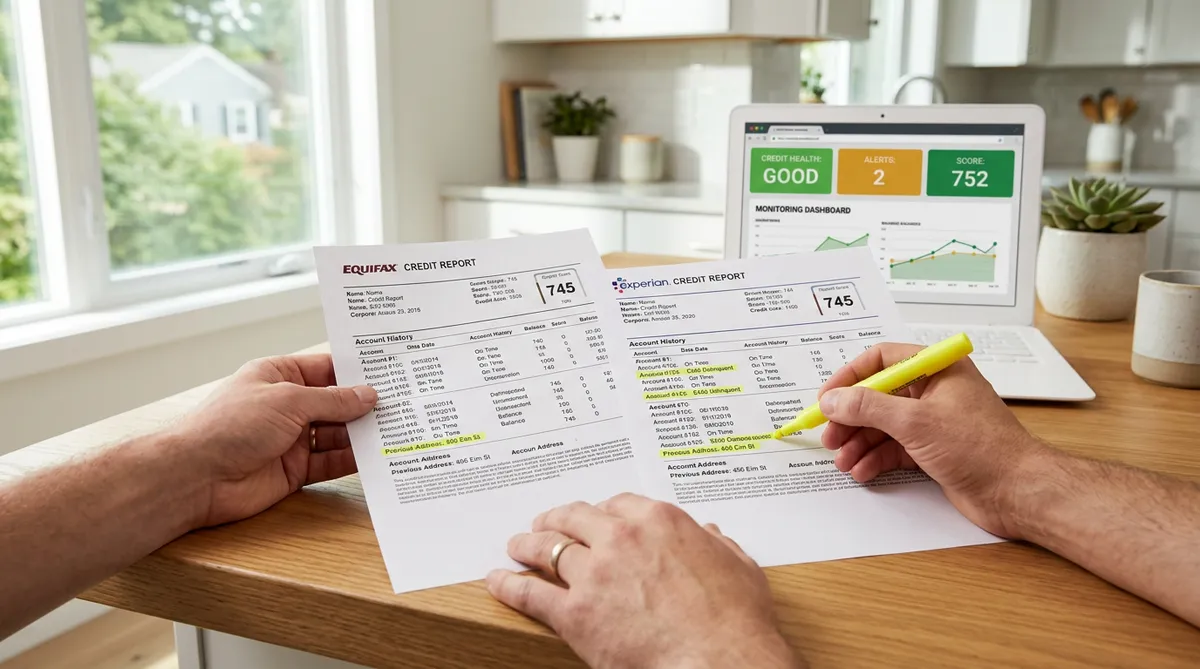
One of the most valuable things about monitoring both bureaus is the ability to cross-reference your reports and catch mistakes. Credit report errors are not rare in Canada. Incorrect balances, accounts that do not belong to you, or debts incorrectly listed as unpaid can all drag your score down without your knowledge.
Here is a practical approach:
- Pull both reports the same week. Log into Borrowell and Credit Karma within a few days of each other so you are comparing roughly the same time period.
- List all accounts on each report. Check that every account listed on your Equifax report also appears on your TransUnion report, and vice versa. If an account is missing from one, it may simply mean that lender only reports to one bureau. But if a negative item appears on one report and you believe it is inaccurate, that is a red flag.
- Compare balances and statuses. For accounts that appear on both reports, verify the balances, credit limits, and payment statuses match. A discrepancy could indicate a reporting error.
- Check personal information. Make sure your name, address, and employer are correct on both reports. Errors in personal information can sometimes lead to mixed files, where another person’s credit data is merged with yours.
- Dispute errors with the correct bureau. If you find an error on your Equifax report, file a dispute with Equifax Canada. If the error is on TransUnion, file with TransUnion Canada. You have the right to dispute inaccurate information under guidelines set by the Financial Consumer Agency of Canada (FCAC).
If you find errors that are hurting your score, fixing them can produce a meaningful improvement. Use our credit score impact calculator to estimate how much a correction could help, and take our recovery quiz to get a step-by-step plan tailored to your situation.
Frequently Asked Questions
Is Borrowell more accurate than Credit Karma Canada?
Neither one is more or less accurate. Borrowell shows your real Equifax score and Credit Karma shows your real TransUnion score. Both are legitimate credit scores that lenders may use. The difference between them comes from the underlying data at each bureau and the scoring model each bureau uses, not from any inaccuracy on the part of Borrowell or Credit Karma.
Will signing up for Borrowell or Credit Karma hurt my credit score?
No. Both platforms perform a soft credit inquiry when you sign up and when they update your score. Soft inquiries are not visible to lenders and have zero effect on your credit score. You can check your score on both platforms as often as you want without any negative impact.
Which free credit score do mortgage lenders in Canada use?
Mortgage lenders in Canada typically pull from both Equifax and TransUnion. Many mortgage lenders and mortgage insurers use the lower of the two scores for qualification. This is why it is important to monitor both scores if you are planning to buy a home. If one score is significantly lower, investigate why and address any issues before applying. Our guide on rebuilding credit after bankruptcy in Canada includes strategies that apply to anyone working to raise their score before a major application.
My Borrowell score dropped but Credit Karma stayed the same. What happened?
This usually means something changed on your Equifax file but not your TransUnion file. Common causes include a new hard inquiry from a lender that only checked Equifax, a balance increase that was reported to Equifax before TransUnion, or a negative item (late payment, collections account) that appeared on your Equifax report but has not been reported to TransUnion. Log into Borrowell, review your full Equifax report, and look for any new items or changes since your last check.
The Bottom Line
Borrowell and Credit Karma Canada are both valuable tools, and neither one is better or worse than the other. They serve different purposes because they draw from different data sources. Borrowell gives you your Equifax picture, and Credit Karma gives you your TransUnion picture. Together, they give you the complete view.
If you are serious about understanding and improving your credit in Canada, sign up for both, check them regularly, and use the comparison to catch errors, track your progress, and make informed decisions before applying for credit. Pair that monitoring habit with a clear rebuilding strategy, whether that involves a secured credit card, a credit builder product, or targeted dispute work, and you will be in a much stronger position than the vast majority of Canadians who never look at their credit reports at all.
Not sure where to start? Take our recovery quiz for a personalized plan based on your current score, credit history, and financial goals.
The information in this article is for educational purposes and does not constitute financial advice. Credit scores, platform features, and lender policies can change. Always verify current details directly with the relevant provider. Credit Score Hero may receive compensation through affiliate links, which helps support this free resource at no additional cost to you.
Get Your Personalized Recovery Plan
Answer 6 quick questions and get a step-by-step plan tailored to your situation.
Take the Free Quiz Product manager in fintech, immigrant to Canada, and founder of Credit Score Hero. I moved from Kyrgyzstan to Montreal in 2022 and built this site to help Canadians navigate the credit system with free tools and honest, Canada-specific advice.