Credit Utilization Ratio in Canada: The 30% Rule Is Wrong (Here's Why)
The 30% credit utilization rule is outdated. Learn what actually matters for your credit score in Canada and the real numbers that move your rating.

Product Manager in Fintech · Montreal, Canada
Ready to start recovering? Our free quiz creates a personalized plan for your exact situation.
Take the Free Quiz →Every credit advice article on the internet says the same thing: keep your credit utilization below 30%. It’s repeated so often that most Canadians treat it like a hard rule baked into the scoring algorithm. But it’s not. The 30% number is a rough guideline from the early 2000s, and if you’re actually trying to maximize your credit score in Canada, following it blindly can cost you points.
I work in financial services in Canada, and I see real credit data every day. The people with 800+ scores? Most of them aren’t sitting at 29% utilization. They’re at 1-9%. And the difference between 25% and 5% utilization can mean 40-60 points on your Equifax Canada score. That’s the gap between getting approved for a mortgage and getting declined.
What Is Credit Utilization, and How Does It Work in Canada?
Credit utilization is the percentage of your available revolving credit that you’re currently using. If you have a credit card with a $5,000 limit and a $1,500 balance, your utilization is 30%. Both Equifax Canada and TransUnion Canada track this number, and it makes up roughly 30% of your overall credit score calculation. It’s the second-biggest factor after payment history.
Here’s what most people miss: utilization is calculated on the statement date, not the due date. Your credit card issuer reports your balance to the bureaus once per month, usually on your statement closing date. So even if you pay your full balance by the due date every single month, you could still show high utilization if you had a large balance when the statement closed.
This matters because the timing creates a snapshot problem. You might be financially responsible, but your credit report tells a different story for 30 days.

Why Does Everyone Say 30%? Where Did That Number Come From?
The 30% rule traces back to general advice from FICO in the United States during the early 2000s. American personal finance writers repeated it, Canadian writers copied them, and now it’s treated as gospel. But neither Equifax Canada nor TransUnion Canada has ever published “30%” as an official threshold. The scoring models use utilization as a continuous variable. Lower is better. There’s no magic cutoff at 30%.
A 2023 analysis by Borrowell (one of Canada’s largest free credit monitoring platforms) found that Canadians with scores above 800 had an average utilization of 7%. Not 30%. Not even 20%. Seven percent.
That said, the 30% guideline isn’t completely useless. If you’re at 70% utilization, getting below 30% will absolutely help your score. But treating 30% as a target rather than a ceiling is where people go wrong. It’s like saying “don’t fail the exam” when you should be aiming for an A.
What Utilization Percentage Actually Gives You the Best Score in Canada?
Based on data from Equifax Canada and patterns I’ve seen working in financial services, here’s roughly how utilization brackets affect your score:
- 0%: Slightly worse than 1-3%. Having zero reported activity can signal inactivity.
- 1-9%: The sweet spot. This is where you want to be if you’re aiming for 750+.
- 10-29%: Good. You won’t lose many points here, but you’re leaving some on the table.
- 30-49%: This is where the damage starts. Expect a noticeable dip.
- 50-74%: Significant score reduction. Lenders see risk.
- 75%+: Major red flag. Your score takes a serious hit.
The gap between 25% utilization and 5% utilization can be 40-60 points on your score. If you’re applying for a mortgage in Canada, those points matter. The difference between a 720 and a 760 could mean a 0.15-0.25% lower interest rate, which on a $500,000 mortgage adds up to thousands of dollars over the amortization period.
How Did I Learn This the Hard Way?
When I bought my house in Canada, I ran into exactly this problem. I had a solid credit score, but during the purchase process there were expenses everywhere: renovation costs, property taxes, legal fees, land transfer tax. I started putting things on my credit cards because the cash was tied up in the down payment and closing costs.
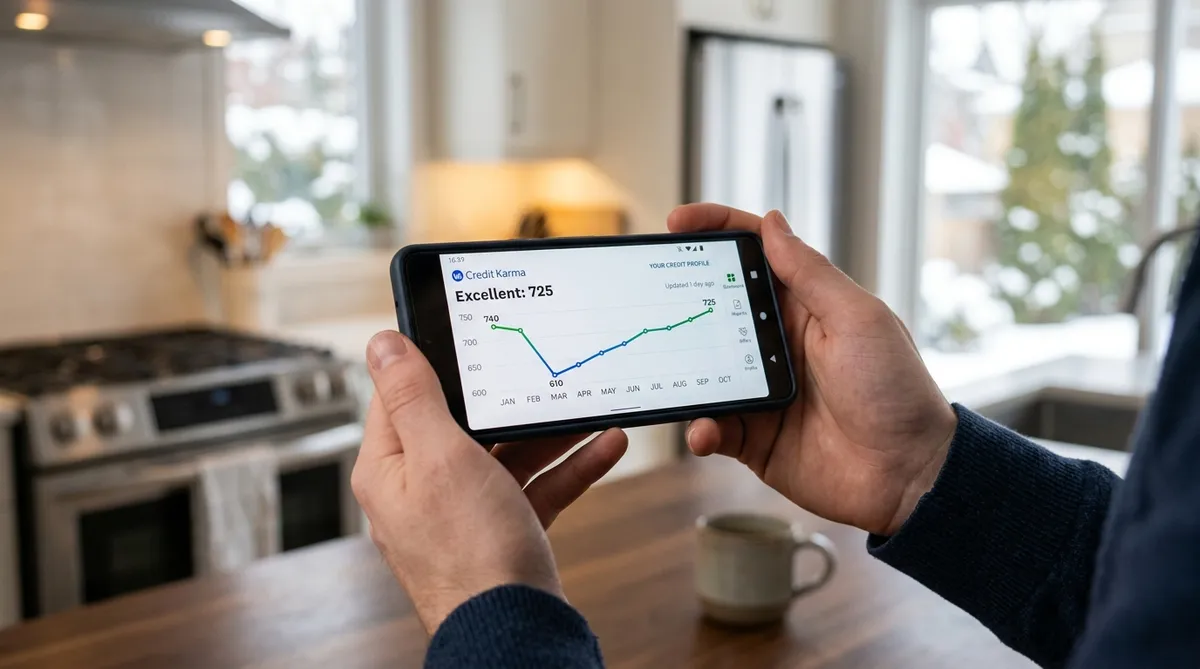
My utilization shot up, and I watched my score drop. I also applied for a line of credit during this period, and got declined. The reason? I hadn’t been in Canada long enough. So I was stuck with high credit card balances, no line of credit to consolidate, and a falling score right when I needed it most.
That experience taught me that utilization isn’t just a number on a report. It’s a real constraint that can limit your options at the worst possible time. If I’d understood the actual utilization brackets (not just “stay under 30%”), I would have managed my spending differently during the home purchase.
Does Per-Card Utilization Matter, or Just the Total?
Both Equifax Canada and TransUnion Canada look at two types of utilization: per-card and overall. Your overall utilization is the total of all your revolving balances divided by the total of all your limits. Per-card utilization looks at each card individually.
Here’s a practical example. Say you have two credit cards:
- Card A: $10,000 limit, $2,800 balance (28% utilization)
- Card B: $5,000 limit, $200 balance (4% utilization)
- Overall: $3,000 / $15,000 = 20% utilization
Your overall utilization looks fine at 20%. But Card A is at 28%, which is creeping toward the zone where it starts hurting. If Card A had $4,500 on it instead (45% per-card utilization), your overall might still be under 30%, but that one maxed-out card sends a negative signal.
The practical takeaway: spread your spending across cards if you have more than one. Don’t concentrate everything on a single card while others sit at zero.
What About Authorized User Cards and Secured Cards?
If you’re rebuilding credit in Canada with a secured credit card, utilization matters even more. Why? Because your limits are typically low. A Capital One Guaranteed Secured Mastercard starts with a $75 minimum deposit (which becomes your limit). Putting $30 of groceries on that card puts you at 40% utilization instantly.
With a Neo Financial Secured Card ($50 minimum deposit, as of March 2026), even a $20 charge pushes you to 40%. The math works against you when your limits are small.
If you’re using KOHO Credit Builder ($7/month for Essential, $10/month for Extra as of March 2026), the utilization calculation works differently because it reports as an installment-style product to Equifax. But for traditional secured cards, you need to be extra careful about when your statement closes relative to when you pay.
How Can You Lower Your Utilization Right Now?
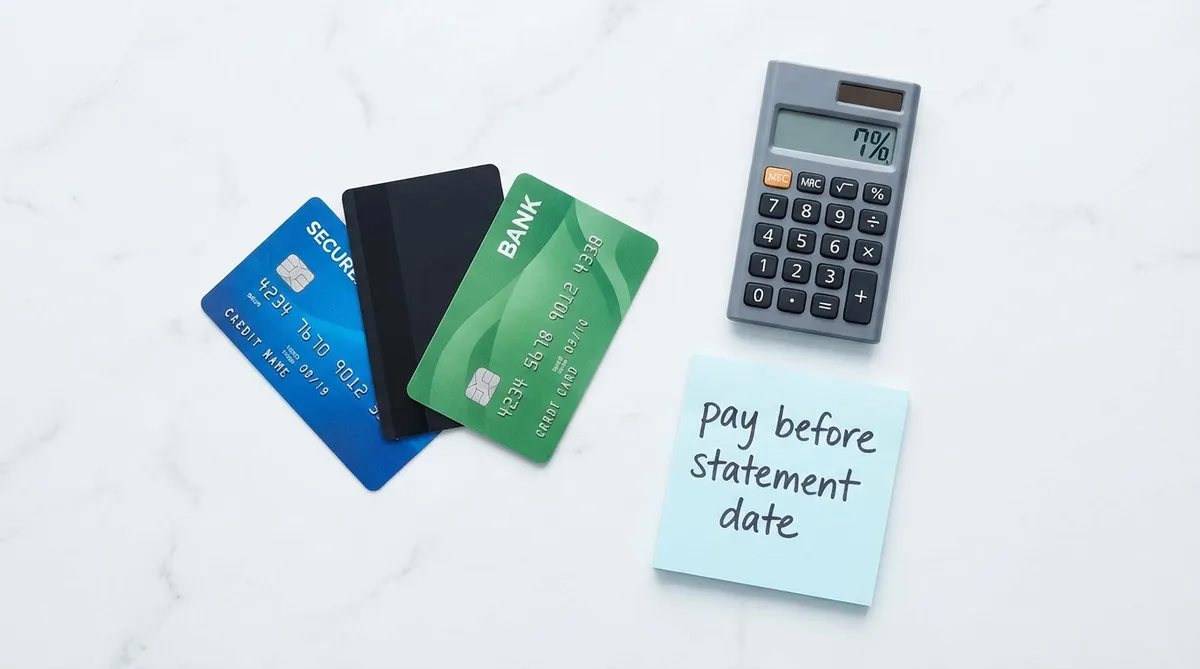
The fastest way to lower your credit utilization in Canada is to pay your balance before your statement closing date — not your due date. You can also request a credit limit increase through your bank’s online portal, which most major Canadian banks allow without a hard inquiry after 6 months of on-time payments. Here are specific tactics you can do this week.
Pay before the statement date. Find out when your credit card statement closes (call the number on the back of your card or check online banking). Pay down the balance a few days before that date. Your reported utilization drops immediately on the next reporting cycle.
Request a credit limit increase. If you’ve had your card for 6+ months and haven’t missed payments, call your issuer. Most Canadian banks (TD, RBC, CIBC, Scotiabank, BMO) will consider an increase without a hard inquiry if you request it through online banking. A higher limit with the same spending = lower utilization.
Don’t close old cards. Closing a credit card removes that limit from your total available credit. If you have a card you don’t use, keep it open and put one small recurring charge on it (like a $10/month subscription). This keeps the account active and your total available credit higher.
Use multiple cards strategically. If your one card is always near its limit, a second card with even a modest limit brings your overall utilization down.
What’s the One Thing About Utilization That Surprised Me Most?
Before I started working in financial services in Canada, I had no idea how hard inquiries and utilization could compound. When I was buying my house, I wanted to finance a refrigerator through Citibank. They pulled a hard inquiry. I waited three weeks for a decision. They declined me. My score dropped about 20 points from the inquiry alone, and that was on top of the utilization hit I was already taking from the home purchase expenses.
What still surprises me about credit in Canada: roughly 30-40% of the population has a score below 600. I came here thinking Canada was a wealthy country where everyone had great credit. The reality is very different. And most of the people I see struggling aren’t irresponsible. They just didn’t understand how the system actually works. The 30% utilization “rule” is a perfect example. It sounds helpful, but it sets the bar too low.
Does Utilization Have Memory in Canada?
Good news: utilization has no memory. Unlike a missed payment (which stays on your Equifax Canada report for 6 years), utilization is recalculated every month based on your latest statement balance. If you’re at 80% utilization today and you pay it down to 5% before your next statement closes, your score reflects the 5% next month. The 80% is gone.
This makes utilization the fastest lever you can pull to improve your credit score. Payment history takes months and years to build. Utilization can change in 30 days.
If you’re about to apply for a mortgage, car loan, or even a new apartment, time your utilization. Pay everything down 1-2 statement cycles before the application. Your score will reflect the lower utilization by the time the lender pulls your report.
So What Should You Actually Aim For?
Aim for 1-9% credit utilization, not 30%. Track your statement closing dates so your reported balance is low when your issuer reports to Equifax Canada and TransUnion Canada. If your spending regularly pushes you above 10%, pay your card twice a month to keep the reported number down. Here’s what to do:
- Target 1-9% utilization if you want the highest possible score
- Track your statement closing dates, not just your due dates
- Monitor both per-card and overall utilization through Credit Karma Canada or Borrowell
- Pay twice a month if your spending regularly pushes utilization above 10%
- Request limit increases every 6-12 months
The 30% rule was always just a simplified version of how it actually works. It’s not wrong in the sense that 30% is better than 60%. But if someone told you the speed limit was 120 km/h when it was actually 100, you’d want to know the real number.
Your credit utilization is the single fastest thing you can fix about your credit score. And now you know the real targets.
Want to see exactly how your utilization is affecting your score? Take our free 90-second credit recovery quiz to get a personalized plan based on your current situation in Canada.
Get Your Personalized Recovery Plan
Answer 6 quick questions and get a step-by-step plan tailored to your situation.
Take the Free Quiz Product manager in fintech, immigrant to Canada, and founder of Credit Score Hero. I moved from Kyrgyzstan to Montreal in 2022 and built this site to help Canadians navigate the credit system with free tools and honest, Canada-specific advice.