How to Remove Hard Inquiries From Your Credit Report in Canada (2026)
Learn how to remove hard inquiries from your Equifax and TransUnion credit report in Canada, including dispute steps, timelines, and what actually works.

Product Manager in Fintech · Montreal, Canada
Ready to start recovering? Our free quiz creates a personalized plan for your exact situation.
Take the Free Quiz →You applied for a credit card in Canada, got denied, and now your score dropped 10-20 points. The inquiry stays on your report. The card doesn’t. That’s the frustrating part about hard inquiries — you pay the price whether or not you get approved.
But can you actually get them removed? Sometimes. And sometimes it’s not even worth trying. I’ll walk through what works, what doesn’t, and when you should stop worrying about hard inquiries entirely.
What Is a Hard Inquiry on Your Credit Report in Canada?
A hard inquiry (also called a hard pull or hard credit check) happens when a lender requests your full credit report from Equifax Canada or TransUnion Canada to make a lending decision. As of April 2026, each hard inquiry can lower your credit score by 5-20 points, and it stays on your report for 3 years in Canada (compared to 2 years in the US).
Soft inquiries (like checking your own score through Borrowell or Credit Karma Canada) don’t affect your score at all. The difference matters.
Common triggers for hard inquiries in Canada:
- Applying for a credit card (CIBC, TD, Scotiabank, etc.)
- Applying for a mortgage or car loan
- Requesting a credit limit increase (at some banks)
- Applying for a cell phone contract with Rogers, Bell, or Telus
- Renting an apartment (some landlords run hard checks)
- Store financing like The Brick or Leon’s
That last one catches people off guard. A $1,200 couch financed through a store usually means a hard pull from a third-party lender like Fairstone or CitiFinancial.

How Many Points Does a Hard Inquiry Cost in Canada?
Each hard inquiry typically drops your Equifax or TransUnion score by 5-10 points, though the actual impact depends on how thin your credit file is. Someone with 10 years of credit history and multiple accounts might lose 3-5 points. A newcomer to Canada with only one credit card for 8 months? That same inquiry might cost 15-20 points.
The impact fades over time. Most of the score damage happens in the first 3-6 months. By month 12, the inquiry is still on your report but has minimal effect on your score.
And here’s something most guides written for Americans get wrong: in Canada, hard inquiries stay on your Equifax report for 3 years, not 2. TransUnion Canada also keeps them for 3 years. That’s a full year longer than the US.
When I learned this the hard way
When I was buying my home, I wanted to finance a refrigerator through CitiFinancial. They ran a hard inquiry. I waited three weeks for a response, and they denied me. My credit score dropped 20 points, and I got nothing out of it. No fridge, no financing, just a ding on my report that would sit there for 3 years. That experience taught me to always ask “will this trigger a hard pull?” before agreeing to any credit application. I now avoid unnecessary inquiries completely, and my score sits at 820 as of February 2026.
Can You Actually Remove Hard Inquiries in Canada?
You can remove a hard inquiry from your Canadian credit report, but only when the inquiry was unauthorized, duplicated, or the result of fraud or identity theft. Equifax Canada and TransUnion Canada will not remove legitimate inquiries just because you regret the application or got denied.
You CAN get a hard inquiry removed if:
- You never authorized it. A company pulled your credit without your written consent. Under Canada’s Personal Information Protection and Electronic Documents Act (PIPEDA) and provincial privacy laws, they need your permission.
- It was a duplicate. The same lender ran two pulls for one application.
- Identity theft or fraud. Someone applied for credit in your name.
- The company doesn’t exist or can’t verify the inquiry. If the creditor listed on the inquiry can’t produce proof you authorized it, the bureau must remove it.
You CANNOT get a hard inquiry removed if:
- You authorized the check but got denied
- You forgot you applied
- You regret applying
- You think it’s unfair that it dropped your score
I know that’s not what people want to hear. But disputing legitimate inquiries wastes your time and can actually hurt you. Equifax and TransUnion flag frequent frivolous disputes.
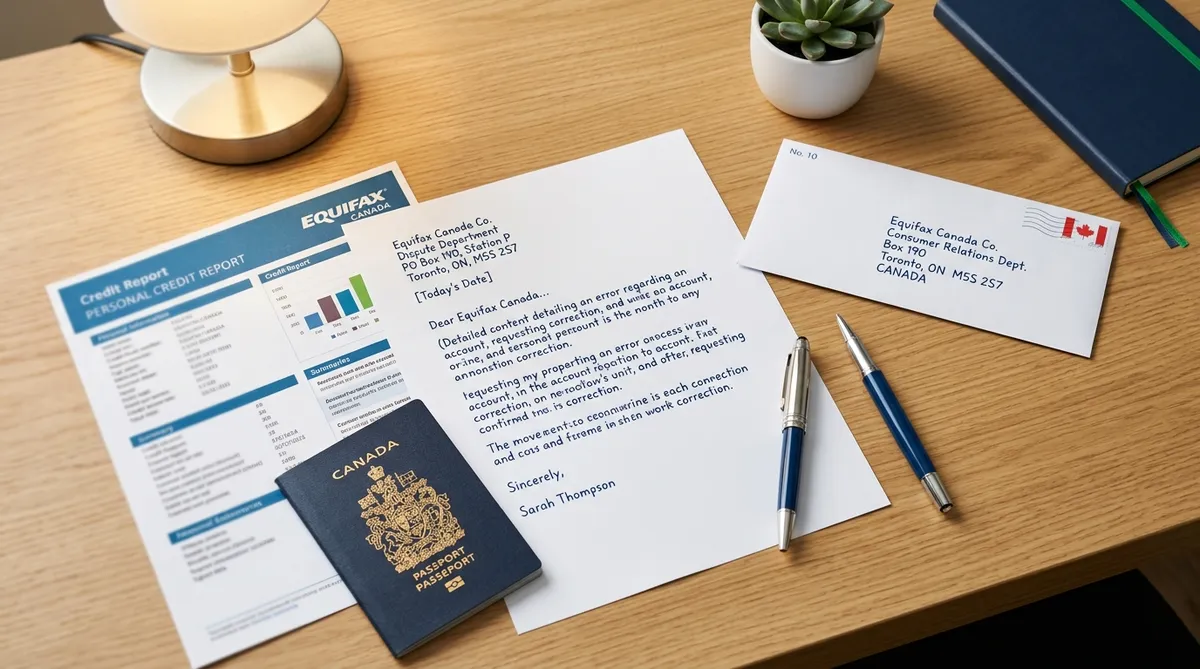
How to Dispute an Unauthorized Hard Inquiry With Equifax Canada
To dispute an unauthorized hard inquiry with Equifax Canada, you need to identify the inquiry on your report, contact the creditor that made it, and then file a formal dispute if the creditor won’t remove it voluntarily. Every Canadian can request a free credit report per year from each bureau through mail or online.
Step 1: Identify the unauthorized inquiry. Log into your Equifax account or review your mailed report. Note the creditor name, date, and type of inquiry.
Step 2: Contact the creditor first. Call the company that made the inquiry and ask them to remove it. If they confirm it was made in error, they can contact Equifax directly. Get this in writing (email counts).
Step 3: File a dispute with Equifax Canada. If the creditor won’t cooperate:
- Online: Through the Equifax Canada dispute portal
- By mail: Equifax Canada, National Consumer Relations, P.O. Box 190, Station Jean-Talon, Montreal, QC H1S 2Z2
- By phone: 1-800-465-7166
Include your full name, SIN (last 4 digits), date of birth, current address, and a clear explanation of which inquiry is unauthorized and why.
Step 4: Wait 30 days. Equifax Canada has 30 days to investigate under PIPEDA guidelines. They’ll contact the creditor. If the creditor can’t verify your authorization, the inquiry gets removed.
You can use our free dispute letter template to draft your dispute. It covers unauthorized inquiries specifically.
How to Dispute a Hard Inquiry With TransUnion Canada
To dispute a hard inquiry with TransUnion Canada, you follow a similar process to Equifax but use TransUnion’s own dispute channels. You’ll need your identification, the specific inquiry details, and a written explanation of why you believe the inquiry was unauthorized.
- Online: Through the TransUnion Canada Consumer Dispute portal
- By mail: TransUnion Consumer Relations, P.O. Box 338, LCD1, Hamilton, ON L8L 7W2
- By phone: 1-800-663-9980
You’ll need to provide the same information: identification, the specific inquiry, and why you believe it’s unauthorized.
One difference I’ve noticed between the two bureaus: TransUnion tends to respond slightly faster (around 20-25 days in my experience tracking this through work). But both are required to investigate within 30 days.
Rate shopping protection in Canada
If you’re applying for a mortgage or auto loan, you get a window where multiple inquiries count as one. Equifax Canada treats all mortgage inquiries within a 45-day window as a single inquiry for scoring purposes. TransUnion uses a 14-day window.
This means you can (and should) shop around for mortgage rates. When I got my mortgage, the broker pulled my report, and then two other lenders did too, all within 3 weeks. It counted as one inquiry on my Equifax report. That’s by design, and it’s one of the rare consumer-friendly parts of the credit system.
Do Hard Inquiry Removal Companies Work in Canada?
Credit repair companies in Canada charge between $500 and $2,000 to remove hard inquiries, but the core service they provide is sending dispute letters to Equifax Canada and TransUnion Canada on your behalf. That’s something you can do yourself for free using our free dispute template.
Some red flags to watch for:
- Guarantees of specific score increases (no one can guarantee this)
- Upfront fees before any work is done (violates consumer protection laws in Ontario and several other provinces)
- Claims they can remove accurate information
- Pressure to create a new “credit identity” (this is fraud under the Criminal Code of Canada)
If you have unauthorized inquiries from identity theft, you’re better off filing a police report and contacting the Canadian Anti-Fraud Centre (1-888-495-8501) directly. That’s free, and it gives you stronger legal standing for disputes.
When Should You Stop Worrying About Hard Inquiries?
Hard inquiries are the least damaging negative item on your Canadian credit report, typically costing 5-20 points and fading in impact within 6-12 months. If your report has late payments, collections, or a consumer proposal, those items are doing far more damage than any inquiry.
| Negative Item | Score Impact | Duration on Report |
|---|---|---|
| Hard inquiry | 5-20 points | 3 years |
| Late payment (30+ days) | 50-110 points | 6 years |
| Collections account | 100-150+ points | 6 years |
| Consumer proposal | 150-200+ points | 3 years after completion |
| Bankruptcy | 200+ points | 6-7 years after discharge |
If your credit report has late payments, collections, or a consumer proposal on it, focusing on hard inquiries is like rearranging deck chairs. Fix the big stuff first.
Through my work in financial services, I see this pattern constantly. People obsess over 2-3 hard inquiries when they have a collections account dragging their score down by 120 points. The inquiries are noise. The collections account is the signal. If that sounds like your situation, the credit recovery quiz can help you figure out what to prioritize.

How to Prevent Unnecessary Hard Inquiries in Canada
The best way to protect your credit score from hard inquiry damage is to avoid unnecessary pulls in the first place, since prevention is far easier than trying to get inquiries removed after they’re on your report. Here are the most effective strategies.
Ask before you apply. Before any credit application, ask the lender: “Will this be a hard or soft inquiry?” Get the answer in writing if possible. Some credit limit increases at CIBC and RBC are soft pulls. Others aren’t. The only way to know is to ask.
Pre-qualification tools. Several Canadian lenders offer pre-qualification checks that use soft pulls. Capital One Canada’s pre-approval tool, for example, checks your eligibility without a hard inquiry. Neo Financial also offers a soft-pull pre-check for their secured card.
Bundle your rate shopping. If you’re applying for a mortgage, do all your applications within a 14-day window (the TransUnion safe window) to minimize inquiry damage. Better yet, use a mortgage broker. They typically submit to multiple lenders with a single pull.
Monitor your reports. Check your Equifax and TransUnion reports regularly through free services like Borrowell (Equifax) and Credit Karma Canada (TransUnion). If an inquiry appears that you didn’t authorize, dispute it immediately. Don’t wait. I monitor mine through Credit Karma, and it’s caught things I wouldn’t have noticed otherwise, including a telecom company that started a credit account I never agreed to.
Don’t apply for store financing. That 0% interest deal on a $900 mattress at Sleep Country? It triggers a hard inquiry through a third-party lender. Pay cash or use a credit card you already have. The temporary 0% isn’t worth a 3-year mark on your report.
What if You Have Too Many Hard Inquiries Already?
If you already have multiple hard inquiries on your Canadian credit report, the good news is that their score impact fades steadily over time and they fall off your report entirely after 3 years. Don’t panic. Here’s a realistic timeline:
- Months 1-6: Maximum score impact. Avoid new applications if possible.
- Months 7-12: Impact fading. Your score starts recovering.
- Months 13-24: Minimal impact on your score, though inquiries still visible.
- Months 25-36: Inquiries fall off your report entirely.
While you wait, focus on the factors that matter more: keep your credit utilization below 30%, pay every bill on time, and don’t close old accounts. These three things account for roughly 65% of your credit score in Canada. Hard inquiries? About 10%.
If your score needs faster recovery, a credit builder product like KOHO ($7/month for Essential, $10/month for Extra) reports positive payment history to Equifax monthly. That positive reporting can offset inquiry damage within 3-4 months. It’s not magic, but the math works. A 5-point drop from an inquiry gets buried under months of on-time payments.
The Honest Answer About Hard Inquiries in Canada
Most hard inquiries on your Canadian credit report cannot be removed and genuinely don’t need to be. The only inquiries worth disputing are ones you never authorized, and that process is straightforward and free through both Equifax Canada and TransUnion Canada.
Your energy is better spent on payment history and utilization than chasing inquiry removals. And if you’re not sure where your score stands or what’s actually dragging it down, take our free credit recovery quiz. It takes 90 seconds and gives you a prioritized action plan based on your specific situation in Canada.
Get Your Personalized Recovery Plan
Answer 6 quick questions and get a step-by-step plan tailored to your situation.
Take the Free Quiz Product manager in fintech, immigrant to Canada, and founder of Credit Score Hero. I moved from Kyrgyzstan to Montreal in 2022 and built this site to help Canadians navigate the credit system with free tools and honest, Canada-specific advice.