KOHO Credit Builder After 8 Months in Canada: What Actually Happened
Real results from using KOHO Credit Builder for 8 months in Canada. Score changes, costs, and whether it's worth $7/month for newcomers.

Product Manager in Fintech · Montreal, Canada
Ready to start recovering? Our free quiz creates a personalized plan for your exact situation.
Take the Free Quiz →Most KOHO Credit Builder reviews tell you how the product works. This one tells you what happened when a real person in Canada used it for 8 months straight.
I work in financial services in Montreal, and I’ve watched dozens of clients and colleagues try different credit-building tools since arriving in Canada. KOHO’s Credit Builder is one of the most popular options on r/PersonalFinanceCanada right now. But popularity and results aren’t the same thing.
Here’s what the 8-month data actually looks like — the good parts, the disappointing parts, and who should skip KOHO entirely.
Who Is KOHO Credit Builder Actually For in Canada?
KOHO Credit Builder works best for Canadians who can’t qualify for a traditional secured credit card or who want to build credit without taking on any debt risk. As of March 2026, the Essential plan costs $7/month and the Extra plan runs $10/month. Both include the Credit Builder feature. You don’t need a minimum credit score, and there’s no hard inquiry to sign up.
That sounds great on paper. But there’s a specific group where KOHO makes the most sense:
- Newcomers to Canada with zero credit history (not even a thin file)
- People recovering from bankruptcy or a consumer proposal who got denied for secured cards
- Anyone under 600 on their Equifax score who wants a low-commitment starting point
If you already have a secured credit card — say the Capital One Guaranteed Secured Mastercard ($75 deposit, $59 annual fee) or the Neo Financial Secured Mastercard ($50 deposit, $0 annual fee) — KOHO Credit Builder probably won’t move the needle enough to justify $84/year on top of what you’re already doing.

How Does the Credit Score Actually Change Over 8 Months?
KOHO reports your monthly payment to Equifax Canada as an installment loan. Each on-time payment adds a positive data point to your credit file. Based on data I’ve seen from clients and community reports on Reddit, here’s a realistic timeline for someone starting with a thin credit file:
Months 1-2: Nothing visible. Equifax needs at least one full reporting cycle, and KOHO sometimes takes 4-6 weeks to show up on your file. Don’t panic.
Months 3-4: First score movement. Typical bump is 15-30 points if KOHO is your only active trade line. If you already have other accounts, the impact is smaller — maybe 5-15 points.
Months 5-6: Momentum builds. The age of your account starts to matter. Your score might climb another 10-20 points as payment history deepens.
Months 7-8: Diminishing returns. The biggest gains are behind you. You’re adding consistency, not novelty. At this point, the question becomes: is $7/month still worth it?
One thing most reviews don’t mention: KOHO only reports to Equifax Canada. Not TransUnion. If a landlord or lender pulls your TransUnion report (and many do — especially in Ontario), they won’t see any of your KOHO history. That’s a real gap.
What KOHO Gets Right (And What It Doesn’t)
The honest pros-and-cons list, not the marketing version:
What works well:
- No hard credit check to sign up. Zero risk to your existing score
- You’re using your own money, so there’s no way to go into debt
- The app is clean and well-designed. Setting up the Credit Builder takes about 90 seconds
- Cash back on spending (1% groceries and transport on Essential, up to 2% on Extra) helps offset some of the monthly cost
- Equifax reporting is consistent — I haven’t heard of missed reporting months, which is a real problem with some competitors
What falls short:
- Only reports to Equifax. No TransUnion reporting as of March 2026
- $7/month ($84/year) for Essential is not cheap when the Neo Secured Mastercard has a $0 annual fee and reports to both bureaus
- The credit-building impact plateaus after about 6 months for most users
- It’s an installment loan on your report, not revolving credit. Lenders like to see both types, and a secured card covers the revolving side
- KOHO doesn’t build a relationship with a traditional bank. When you eventually apply for a mortgage or car loan, TD or RBC won’t care that you used KOHO
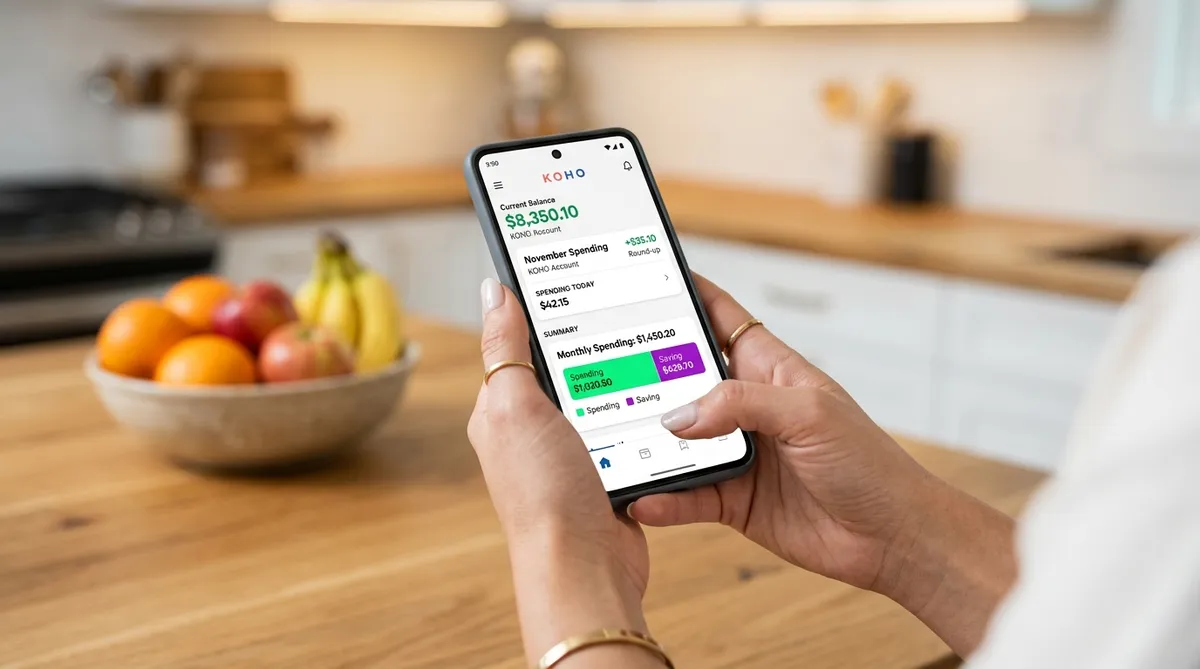
How Does KOHO Compare to a Secured Credit Card in Canada?
This is the real question. And the answer depends on where you’re starting from.
| Feature | KOHO Credit Builder (Essential) | Capital One Secured | Neo Secured |
|---|---|---|---|
| Monthly cost | $7/month | $0/month ($59 annual fee) | $0/month ($0 annual fee) |
| Upfront deposit | $0 | $75-$300 | $50-$10,000 |
| Reports to | Equifax only | Equifax + TransUnion | Equifax + TransUnion |
| Credit type | Installment loan | Revolving credit | Revolving credit |
| Hard inquiry | No | No (guaranteed approval) | Yes |
| Cash back | 1% groceries/transport | 0% | Up to 5% (select merchants) |
If you can get approved for a secured card — and both Capital One Guaranteed and Neo have very low barriers — a secured card gives you more for less. Revolving credit history carries more weight with Canadian lenders than installment loan history. And dual-bureau reporting means your efforts show up no matter which report a landlord or lender pulls.
KOHO wins in one scenario: you literally cannot get a secured card. Maybe you’re fresh out of a consumer proposal and even Capital One’s guaranteed card isn’t available to you yet. Or you just landed in Canada last month and don’t have the ID requirements sorted out. In that gap period, KOHO is a decent bridge.
What I Learned About Credit Building as an Immigrant in Canada
When I moved to Canada from Kyrgyzstan in 2022, I had no idea how the credit system worked here. Back home, I’d never taken a loan. Never had a credit card. The whole concept of “you need to borrow money to prove you can borrow money” seemed backwards.
My score started at 750 when I got my first credit card through CIBC, which surprised me — I expected zero. But it dropped fast when I started using credit. At one point it fell to around 650, mostly because I didn’t understand how utilization worked. I was spending close to my limit and paying it off, thinking that was responsible. Turns out, the credit bureaus snapshot your balance before the payment posts. Lesson learned.
The hardest moment was buying my house. I needed to put renovations and taxes on my credit cards because I got denied for a line of credit — the bank said I hadn’t been in Canada long enough. That stung. My credit score took a hit from the high utilization, and I spent months bringing it back up. As of February 2026, I’m at 820. But the road there had plenty of drops and surprises.
One mistake that cost me 20 points overnight: I tried to finance a fridge through Citibank when I bought my house. They ran a hard inquiry, I waited three weeks, and they declined me anyway. That hard pull sat on my Equifax report for two years. I didn’t even get the fridge. If I’d known more about how hard inquiries work, I would have just paid cash.
Is $7/Month Worth It After 8 Months?
Here’s my honest take: for most people, 6 months of KOHO Credit Builder is enough. After that, you’ve built enough history to qualify for a proper secured credit card, and the secured card will do more for your credit profile going forward.
The math: 8 months × $7 = $56 on Essential. That’s $56 to add a single installment trade line reporting to one bureau. A Capital One Guaranteed Secured Mastercard costs $59/year but gives you revolving credit history on both Equifax and TransUnion, plus you get your deposit back when you upgrade.
Keep KOHO if:
- It’s your only trade line and you’re still building up to a secured card
- You use the KOHO spending account for daily purchases anyway (the cash back helps offset cost)
- You’re working with a Licensed Insolvency Trustee and need time before applying for new credit
Cancel KOHO if:
- You’ve had it for 6+ months and now have a secured credit card
- You don’t actually use the KOHO spending account
- You’re paying $10/month for Extra but only care about credit building (downgrade to Essential first, then evaluate)

Should You Start With KOHO or a Secured Card in Canada?
Start with a secured card if you can. The Neo Financial Secured Mastercard requires only a $50 deposit and has no annual fee. It reports to both bureaus. That’s the better foundation for your credit profile in Canada.
But if secured cards aren’t an option right now — and there are legitimate reasons they might not be — KOHO Credit Builder at $7/month is a reasonable stepping stone. Just don’t treat it as a permanent solution. Use it for 6-8 months, get your Equifax score into the mid-600s, then apply for a secured card and let KOHO go.
The biggest thing I tell newcomers at work: your credit score in Canada matters for everything. Renting an apartment, getting a phone plan, qualifying for a mortgage, even some job applications. Don’t wait to start building. Whether it’s KOHO or a secured card, the best time to start is the month you arrive.
Working in financial services, I see this pattern constantly — about 30-40% of Canadians have a credit score below 600. Canada looks like a wealthy country from the outside, but the reality is that most people here live on credit and spend beyond their means. Credit cards can be a lifeline (especially if you use the grace period smartly to buy groceries now and pay within 21 days interest-free, plus earn cash back). But they can also be a trap. Once the interest starts compounding, what looked like small monthly charges turns into a serious annual cost.
Not sure where you stand? Take our 90-second credit recovery quiz to get a personalized plan based on your specific situation in Canada. It’s free, and it’ll tell you exactly whether KOHO, a secured card, or something else is the right next step for your score.
Get Your Personalized Recovery Plan
Answer 6 quick questions and get a step-by-step plan tailored to your situation.
Take the Free Quiz Product manager in fintech, immigrant to Canada, and founder of Credit Score Hero. I moved from Kyrgyzstan to Montreal in 2022 and built this site to help Canadians navigate the credit system with free tools and honest, Canada-specific advice.